This June 3, 2026's Issue · Vol. 2, No. ∞ · Falls Church, VA
"The Nation's Most Trusted Source for Questionable Information."
Before we get to ourselves — and we will — here is something that was doing this long before we showed up.
Nature led with this. We’re not so vain as to put our own coverage first.
Every issue, starting with the latest. Step through, or surrender to chance.

"All the news that fits, we print. The rest we frame." — The Lampoon Institute for Front-Page Composure
★About Us
Shining a light on the absurd since 1978 — give or take.
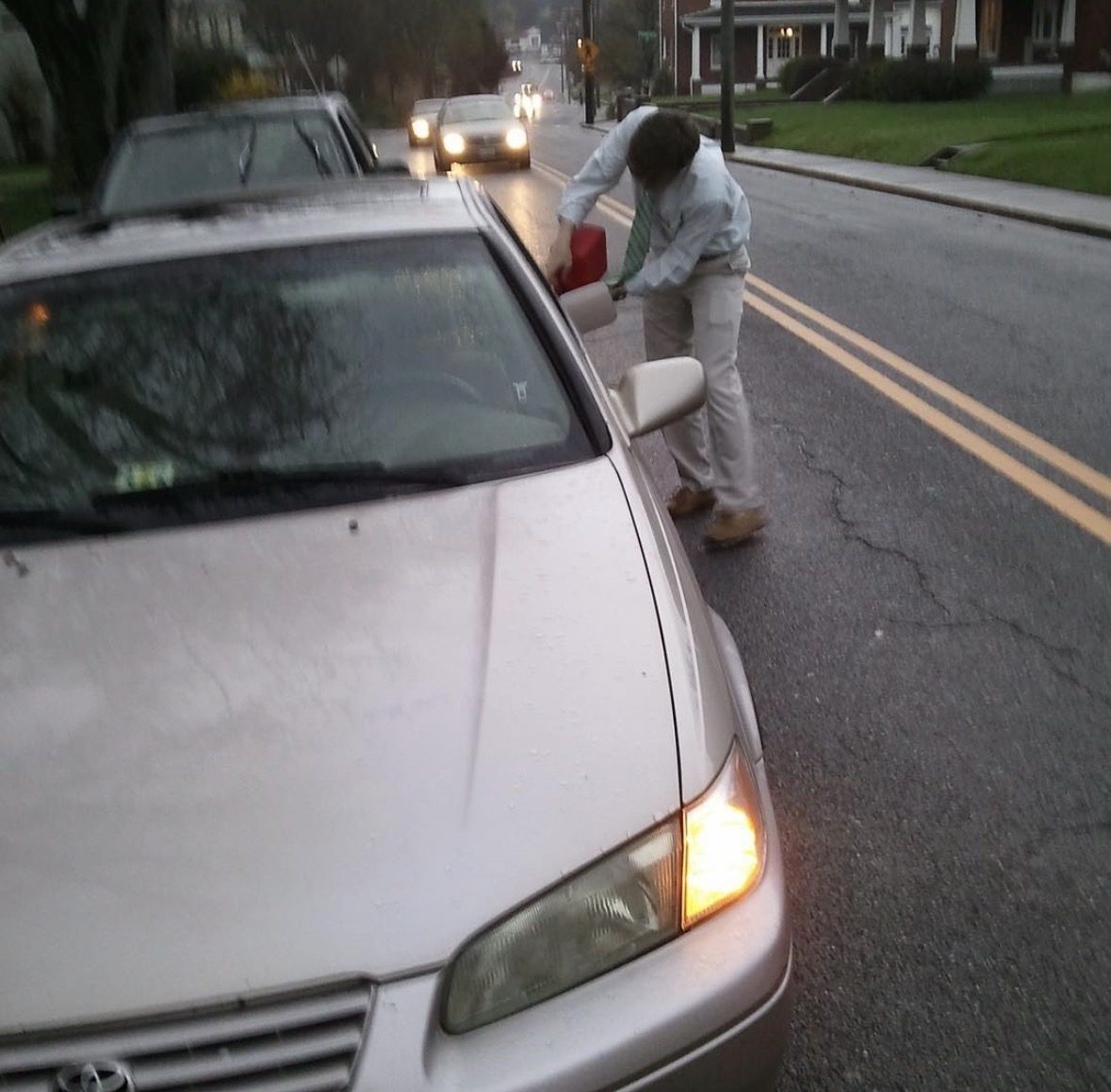
We're still working on filling it all up — the page, the tank, and the conspicuous gap where an explanation should go. Please be patient.

The Editor-in-Chief
This section is under construction by people who are very confident and occasionally correct.
Full details are forthcoming. The editors are presently workshopping a version of events that is flattering, defensible, and only loosely related to what actually happened.
Check back soon — or don't. We'll be here either way, datelined Falls Church, Virginia, arguing about a comma.
The Editor, Defined · A Brief Lexicon
1.Pleasant in a manner that discourages follow-up questions. 2.(editorial) A quality one asserts about oneself at precisely the frequency required to make it suspect. See also: harmless; well-meaning; “no notes.”
1.A person, gender approximately male, here functioning as the standard unit of unremarkable humanity. 2.The smallest indivisible quantity of a man who “means well.”
1.Indicating origin, as carefully distinguished from credentials. 2.A word performing enormous load-bearing labor in any sentence that follows it with a place and then stops.
1.A commonwealth — not a state, a distinction its residents will clarify unprompted. 2.The dateline of record for this publication; see Falls Church. 3.Mother of Presidents, several of whom would not clear modern onboarding.
1.Enthusiastic, plus a quantity of enthusiasm the room did not request. 2.The clinical condition of replying-all. 3.Earnestness presenting without a clear exit.
The Editor, At Length
A curriculum vitae that quietly insisted on becoming a narrative.
Zachary “Zach” Loarn Upchurch hails from Orange, VA — by way of Inova Fairfax. He graduated with honors* from “Orange County High Schoo.”
Afterward, he attended Virginia Polytechnic Institute and State University,** where he studied biological sciences with an option in microbiology/immunology. Beginning in his very first spring semester, he worked across three different labs, where he was fortunate enough to have incredible mentors who pushed his potential.
That was followed by a year spent building and running a volunteer scribe program, from the ground up, at the now-shuttered Moss Free Clinic in Fredericksburg, VA (thanks, Affordable Care Act!).
He was then accepted off the waitlist to complete a master’s in physiology and biophysics at Georgetown University, before spending two years as a scribe and medical assistant at a bustling ENT private practice in Alexandria, VA. Somewhere in there, he realized that ENT is basically all of medicine rolled into one — only more fun, more interesting, and, most importantly, immensely rewarding, for the sheer number of ways it lets you help someone.
He completed his medical education at the American University of the Caribbean School of Medicine, followed by a general surgery preliminary residency at Montefiore Medical Center. In that single year he learned more than he thought possible, helped a great many people, made incredible friends, and — for one glorious stretch — was featured on the ENT program’s marketing materials (screenshots and the Internet Archive are wonderful tools).
He furthered his clinical training with fellowships in medical otorhinolaryngology and laryngology at UF Health Jacksonville, where some of the finest teachers and mentors happened to work — and where, once again, he made incredible friends.
This is, in fact, a running theme of his life: he has been remarkably fortunate to be surrounded by people who saw his potential and pushed him past it. And then there are those who consider him “over-enthused.” That latter group’s special interest, unfortunately, appears to be gatekeeping.
Beyond the interests catalogued here and elsewhere, he enjoys cooking, sight-seeing, art, comedy, museums, horticulture, history, exploration, cycling, golfing, tennis, hockey, hiking, kayaking, podcasts, and a great deal more. He is, after all, at least a bit “more than just a nice guy from Virginia.”
As of June 3, 2026 (give or take a day), he has been working on a side project in the form of a “satirical” news publication — shining a light on the complete absurdity that is the US healthcare system, physician training Nord Stream 2***, and more.
* Runner-up for Most Studious (damn you, Vlad! lol) and tied for Most Likely to Succeed.
** Was a bit of a slacker — graduated with a mere 148 credits, and dropped a 2-credit course on what to do with his degree after graduation because it didn’t seem all that relevant at the time. In retrospect, it was the difference between a second degree and no second degree.
*** A famous pipeline.****
**** A famous, historical pipeline.
Credentials
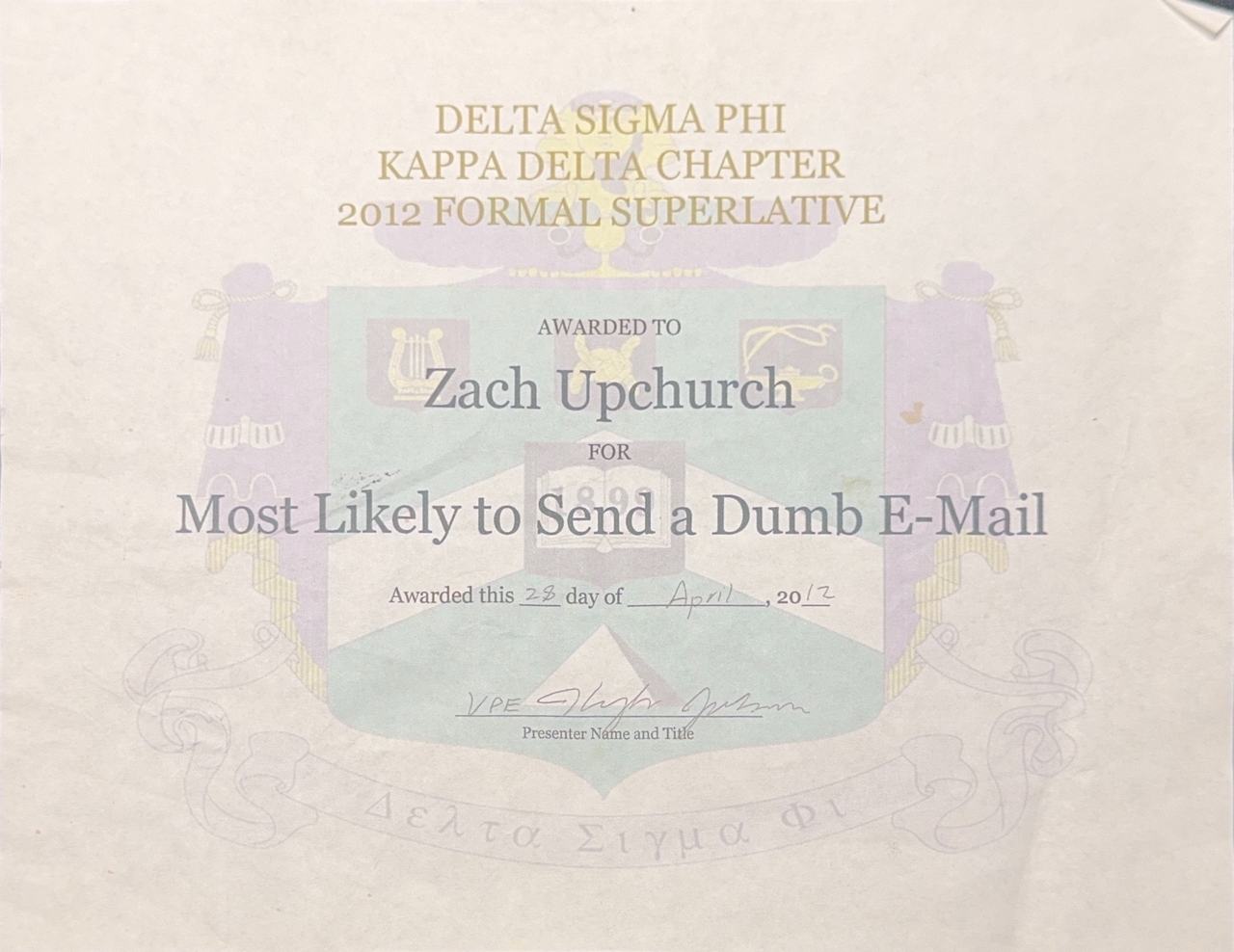
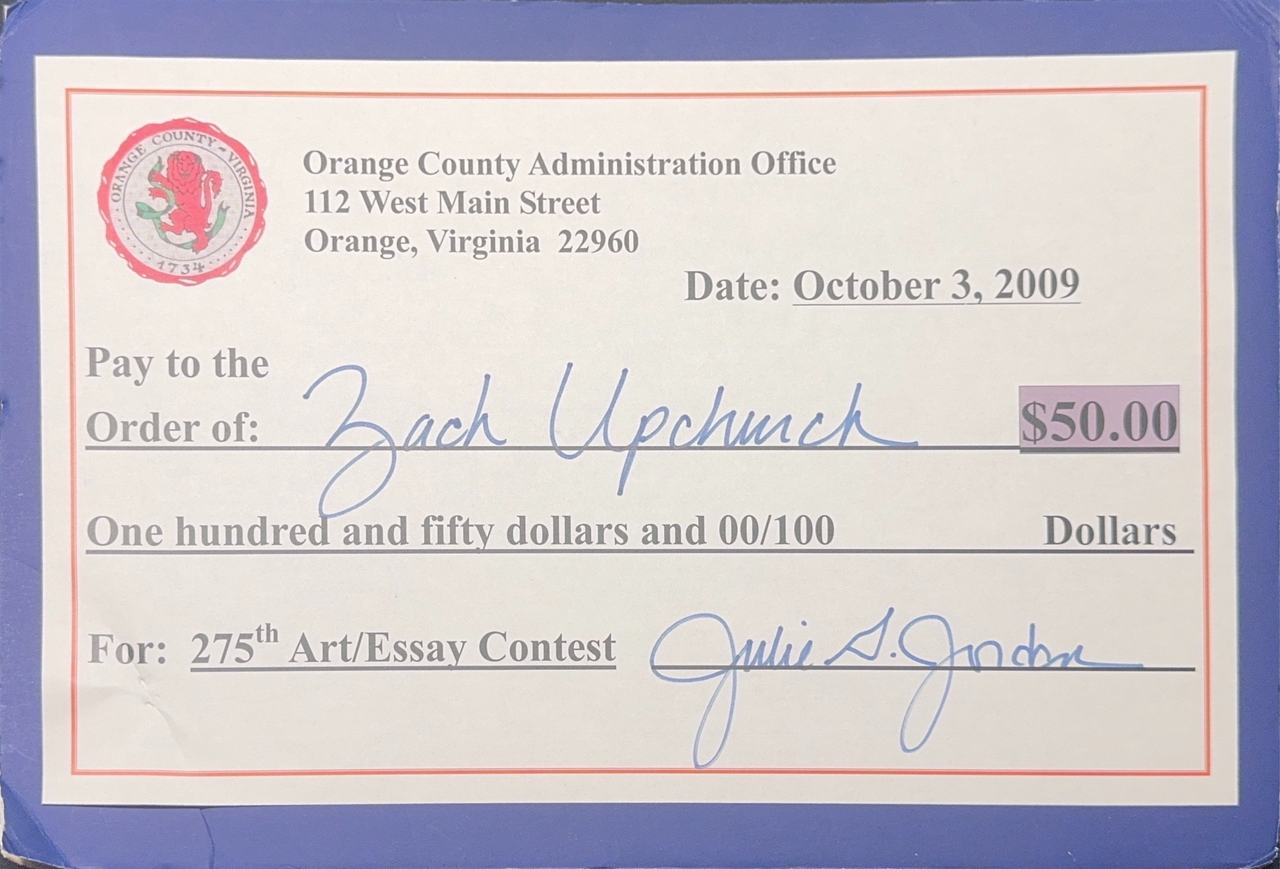
Documentation of the editor's qualifications, achievements, and one unresolved accounting matter.


Arts & Crafts
Where the editors attempt to make things — with their hands, and occasionally with software.
A Collection of Various Ramblings of a (Mad?) Man
Assorted writings that somehow cleared peer review and entered the permanent record.
Against considerable odds, a handful of these ramblings were judged sufficiently coherent to be indexed by the National Library of Medicine. We make no claims as to their lasting significance — only their documented existence.
Catalogued to date: n = 3. Madness: pending peer review. Margin of error: ±1 reviewer who didn't read it.
Presentations
Talks given, grand rounds rounded, and the slide decks that survived them.
A standing collection of lectures, grand rounds, and assorted podium appearances — kept in a shared folder so the deck you half-remember is always a click away. Laser pointer not included.
Earworms*
Operating-room playlists, assembled with the precision of people who own a label maker.
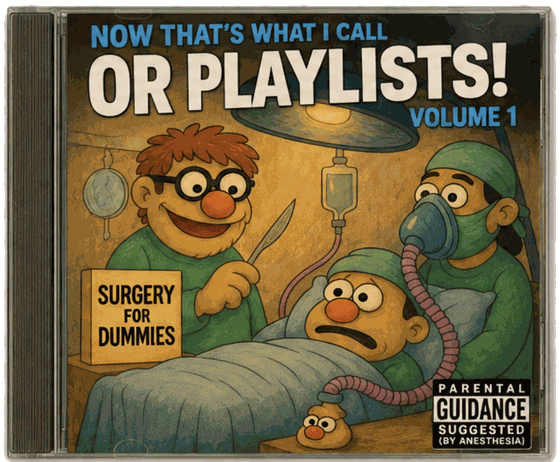


* Unlike cotton swabs, these actually belong in your ears.**
** At a reasonable dB.
"We are exactly who we say we are, pending peer review." — The Lampoon Institute for Self-Description
★
The visual holdings — arts & crafts, the aspiring Looney Tune, and several other collections of variable repute — are housed next door.
The Gallery
Visual holdings of the institute. Swipe through each collection; tap any piece to view it up close.
Additional Arts & Crafts
The hand-made overflow — everything beyond the featured video, and the occasional litigation that follows.
Aspiring Looney Tune
An ongoing application for reclassification as an animated short. The board has not yet ruled.
Inspiration
Images that started something — for better, and occasionally for worse.
Catspiration
The same as the above, but cats. Peer review pending; whiskers throughout.
Mathamemetics
The narrow field in which mathematics and the meme are permitted to coexist.
Clean Up Time
Before, during, and the stage nobody photographs: after.
Good Vibrations
Documented good vibrations, submitted for the record and awaiting replication.
Semi-Pro
Pieces that have cleared the amateur threshold and decline, for the moment, to turn professional.
Brain Fuel
The documented caloric, caffeinated, and otherwise questionable inputs behind the editorial output. Correlation asserted; causation pending peer review.
The Screening Room
Films the editors endorse — with the usual disclaimers, and one or two we invented.
How to Make Money Selling Drugs
2012 · dir. Matthew Cooke · documentary · 96 min
Featuring ‘Freeway’ Rick Ross, David Simon, Susan Sarandon, Woody Harrelson, 50 Cent, Eminem, Russell Simmons, and Arianna Huffington.
* It also truly gets an 11 out of 10 — we just wanted to make sure you were paying attention.
Structured as a brisk instructional ladder — street corner to cartel kingpin, each rung presented as its own little achievement unlocked — the film teaches you the trade with a straight face. Then, having earned your trust, it quietly swaps the syllabus for an indictment of the war on drugs itself. The editors admire any document that smuggles a thesis inside a how-to.
The witnesses are the draw: dealers, narcotics officers, and lobbyists for tougher laws all testify in the same even light, with a supporting cast of celebrities who have, as celebrities do, opinions. Watch for the precise moment the joke stops being a joke. It does not announce itself, which is the point.
Gilly and Keeves
2021– · YouTube · sketch comedy · the full playlist
Shane Gillis and John McKeever, with a rotating company of the Delaware Valley’s finest.
Sketch surgery performed without anesthesia or apology. The Lampoon’s editorial board has watched the entire playlist and bills it as continuing education.
Philly Court
Recurring · the Gilly & Keeves cinematic universe · jurisprudence
The Honorable presiding. Counsel appears unprepared, per local custom.
All rise. The docket is full, the gavel is decorative, and justice is served in a Wawa parking lot. Binding in the Third Circuit, emotionally.
Saturday Morning Classics
Assorted vintages · cereal optional, pajamas mandatory · nine selections
The lineup rotates; the couch does not.
The complete pajama syllabus: nine selections from the golden age of doing absolutely nothing until noon. Attendance is taken by the television.
It’s Always Sunny in Philadelphia
FX · 2005–present · seven selections
Featuring: five co-owners of a bar, none of whom should own a bar.
Paddy’s Pub is the longest-running controlled experiment in American small business: no customers, no ethics, no losses anyone will admit to. The Lampoon’s middlemen coverage owes it a scholarly debt.
Swipe through the exhibits. Each is a masterclass in confidence unsupported by evidence, which is also our editorial model.
That Mitchell and Webb Look
BBC · 2006–2010 · six selections
Featuring: two men asking the questions institutions prefer unasked.
British sketch work of surgical precision: every institution receives exactly the examination it deserves and none of the anesthesia. Required viewing for anyone who has ever sat on, chaired, or fled a committee.
Six selections, each a complete argument. The snooker commentators alone justify the licence fee.
King of the Hill
FOX · 1997–2010 · eight selections
Featuring: a man, his propane, and the narrow alley behind his house.
The most accurate documentary ever animated: work done properly, lawn maintained honestly, feelings expressed exclusively through the word “yep.” Hank Hill sells propane and propane accessories the way this paper sells the truth — quiet conviction, clean margin.
Five exhibits from the alley. Bring a beer and stand at a respectful distance.
Monty Python
BBC · 1969–1974 · six selections
Featuring: the founding faculty of organized absurdity.
The source code. Every argument clinic, dead parrot, and ministry of questionable walks in modern satire compiles against this library, ours included. The Lampoon’s committee jokes are, legally speaking, derivative works.
Six exhibits from the canon, one arriving twenty-one seconds late for reasons the Ministry declines to explain.
The Invention of Lying
Dir. Ricky Gervais & Matthew Robinson · 2009 · three selections
Featuring: the only man on Earth who can say things that aren’t.
A world where everyone speaks the literal truth, until one man discovers the alternative and accidentally invents advertising, religion, and arguably this publication. A satirical premise so clean it needed no second draft.
Three exhibits. In a world without lying, the Lampoon would be a very short paper — every headline already reads like this.
Portlandia
IFC · 2011–2018 · six selections
Featuring: a city where the dream of asking about the chicken is alive.
Field reports from the only municipality that regulates itself entirely through earnestness. Every farmers-market interrogation and artisanal standoff documented here has since been observed in the wild, verbatim.
Six exhibits. Put a bird on the swipe arrows; they were plain and needed meaning.
Malcolm in the Middle
FOX · 2000–2006 · five selections
Featuring: a family conducting five simultaneous experiments in chaos, all successful.
The definitive field study of household governance under total institutional collapse. Hal alone is a complete syllabus in escalation: give the man a model city, a race car bed, or ten thousand bees, and stand back.
Five exhibits, one dynasty of poor impulse control executed at a professional level. The Lampoon’s org chart is based on this family.
The Increasingly Poor Decisions of Todd Margaret
IFC · 2010–2016 · three selections
Featuring: a man for whom every exit is an entrance to something worse.
A controlled demolition of one man’s credibility, conducted in real time and entirely by the man himself. The title is not a premise; it is a legally accurate description, and the show honors it every single scene.
Three exhibits from the descent. Watch the decisions worsen with the discipline of a metronome — ours, specifically, once you turn the humor on.
Blazing Saddles
1974 · dir. Mel Brooks · western comedy · 93 min
Cleavon Little and Gene Wilder, with Harvey Korman, Madeline Kahn, and Slim Pickens.
Mel Brooks, 1974, no notes that anyone would dare deliver. Screened annually by the editorial board for calibration purposes.
Death by Design
1995 · Where Parallel Worlds Meet · documentary · ~73 min
Featuring Polly Matzinger, Rita Levi-Montalcini, Martin Raff, and a quorum of cell biologists on why your cells die precisely on schedule.
A documentary about programmed cell death that has no business being this serene. Six scientists explain apoptosis — the orderly, scheduled self-destruction your cells perform so that you, on the whole, do not — and immunologist Polly Matzinger narrates the machinery of mortality in a voice the editors can only describe as a paradigm shift delivered as a bedtime story.
It is the rare film that makes the immune system sound like weather and dying sound like sensible planning. The Lampoon has, naturally, already covered its triumphant sweep of the Partially-Posthumous Academy Awards. See our coverage →
Nothing to Lose
1997 · dir. Steve Oedekerk · buddy comedy · 98 min
Starring Martin Lawrence and Tim Robbins, with John C. McGinley and Giancarlo Esposito as a rival pair of thieves.
An advertising executive (Tim Robbins) becomes convinced his wife is sleeping with his boss, and on the worst night of his life is carjacked by a broke, fast-talking would-be thief (Martin Lawrence). Rather than surrender his wallet, he floors the accelerator, takes the carjacker hostage, and the two embark on a revenge road trip from California to Arizona. Both men have, as the title is at pains to establish, nothing to lose.
The chemistry is the whole engine — Robbins’s buttoned-down despair against Lawrence’s high-velocity panic — and the plot is, by the studio’s own implication, structurally optional; the detours are the feature. The editors award this hilarious buddy comedy a clean 11 out of 10 and note, for the record, that the downside risk of watching it is definitionally nothing.
The Jerk
1979 · dir. Carl Reiner · comedy · 94 min
Steve Martin (as Navin R. Johnson) and Bernadette Peters, with Carl Reiner appearing as himself.
Navin R. Johnson is raised by Black sharecroppers in Mississippi and reaches adulthood without ever noticing he is the only white person in the family. Sensing a calling the first time he discovers he can keep rhythm to a band on the radio, he leaves home to find his special purpose — works a series of increasingly menial jobs, accidentally invents a gadget that keeps eyeglasses from sliding down the nose, becomes immensely rich, and loses everything when the gadget turns the nation cross-eyed. The family dog is named Shithead. The arc is rags to riches to rags, narrated throughout with total sincerity.
Steve Martin’s first leading role is a master class in playing profound stupidity with complete conviction; the comedy works precisely because Navin never once suspects he is the joke. The editors observe that it takes real intelligence to be this persuasively dim, and award the full eleven.
See No Evil, Hear No Evil
1989 · dir. Arthur Hiller · comedy · 103 min
Gene Wilder (Dave, who is deaf) and Richard Pryor (Wally, who is blind), with Joan Severance and a young Kevin Spacey as the villains.
A deaf man (Wilder) and a blind man (Pryor) who run a corner newsstand together witness the same murder — the deaf one sees the killer, the blind one hears her — which makes them, between the two of them, exactly one reliable eyewitness and the police’s two leading suspects. They go on the run to clear their names, each man covering precisely what the other cannot.
It is the third of the four Wilder–Pryor collaborations, carried almost entirely on their chemistry, with a young Kevin Spacey turning up as a villain. The premise is one joke worked through every available permutation, and the editors found every permutation worth it.
Patch Adams
1998 · dir. Tom Shadyac · comedy-drama · 115 min
Robin Williams (as Hunter “Patch” Adams), with Monica Potter, Philip Seymour Hoffman, Bob Gunton, Daniel London, and Harold Gould — based on the real Dr. Hunter “Patch” Adams.
Robin Williams plays Hunter “Patch” Adams, a man who checks himself into a psychiatric hospital, discovers he is better at reaching the other patients than anyone on staff, and resolves to become the kind of doctor who treats people rather than charts. In medical school he is brilliant and insubordinate in equal measure — slipping onto wards, deploying a red nose and whatever prop the moment seems to demand, and infuriating a dean (Bob Gunton) who regards warmth as a breach of professional distance. It is based, loosely and warmly, on the real Dr. Hunter Adams and the Gesundheit! Institute he founded.
The film’s argument — that a patient is a person, and that laughter, attention, and ordinary kindness are part of the treatment rather than a distraction from it — was made a good two decades before “patient-centered care” turned up on anyone’s mission statement. The editors, who maintain a whole Office of Stakeholder Containment, were unsurprised to watch an institution treat a doctor’s compassion as a disciplinary matter. Williams does the thing only he could: makes earnestness land without a wink. Eleven out of ten; no prior authorization required.
Critical Care
1997 · dir. Sidney Lumet · satire · 107 min
James Spader (as Dr. Werner Ernst), with Kyra Sedgwick, Helen Mirren, Albert Brooks, Anne Bancroft, Jeffrey Wright, and Wallace Shawn.
Sidney Lumet — yes, that Sidney Lumet — turns the intensive-care unit into a satire of American medicine. An idealistic ICU resident (James Spader) is caught between two half-sisters feuding over their comatose father: one wants the plug pulled, the other wants him kept alive indefinitely, and a ten-million-dollar trust fund is quietly informing both positions. Presiding over the ward is a supervisor (Albert Brooks) whose entire diagnostic philosophy is whether the patient’s insurance is still paying.
The film argues, with a straight face, that the modern hospital keeps you alive for exactly as long as someone is being billed for it — a thesis the Lampoon arrived at independently and has filed under Stakeholder Containment. Helen Mirren, Anne Bancroft, and Wallace Shawn (as the Devil) round out the floor. Eleven out of ten; claim submitted.
The Whitest Kids U’ Know
2007–2011 · Fuse, then IFC · sketch comedy · 5 seasons
Trevor Moore, Sam Brown, Zach Cregger, Timmy Williams, and Darren Trumeter.
Five comedians out of New York’s School of Visual Arts who built a following on stage and online before the show landed on Fuse and then IFC, where the absence of commercial breaks and the absence of standards turned out to be mutually reinforcing. The sketches are short, fearless, frequently musical, and aimed squarely at whatever the room has quietly agreed not to bring up.
It is uneven by design and unbothered by the fact — the hit-to-miss ratio is beside the point when the hits go where almost nothing else will. Founding member Trevor Moore, the troupe’s engine, died in 2021; their final project, the animated feature Mars, was finished from material he had signed off on. The editors decline to quote a single sketch in a reputable newspaper, and award the full eleven.
Monk
2002–2009 · created by Andy Breckman · mystery comedy-drama · 8 seasons
Tony Shalhoub as Adrian Monk, with Ted Levine, Bitty Schram, Traylor Howard, and Jason Gray-Stanford.
Adrian Monk is the finest homicide detective in San Francisco and cannot bring himself to touch a doorknob. After his wife Trudy is killed by a car bomb, his grief detonates a constellation of phobias and compulsions — germs, heights, milk, crowds, anything not quite symmetrical — that get him suspended from the force and rehired as a consultant, because the same mind that cannot abide a crooked picture frame cannot stop noticing the one detail that cracks the case.
Tony Shalhoub won three Emmys playing him, and the show’s quiet trick is that the affliction and the gift are the same wiring: the thing that ruins Monk’s morning is the thing that catches the killer. Two uploads are loaded above — swipe to whichever one plays. Eleven out of ten, which Mr. Monk will spend the rest of the day trying to round down.
Mr. Bean
1990–1995 · created by Rowan Atkinson & Richard Curtis · physical comedy · 15 episodes
Rowan Atkinson as Mr. Bean, with Matilda Ziegler as his long-suffering girlfriend Irma Gobb — and a teddy bear named Teddy.
Rowan Atkinson plays a grown man with the disposition of a willful seven-year-old, approaching ordinary tasks — a packed lunch, a dentist’s chair, an exam he plainly did not study for — as though each were a siege to be won by low cunning. He speaks almost not at all; the comedy is built entirely from physical invention, in a line that runs straight back through Jacques Tati to the silent era. His principal co-stars are a teddy bear and a lime-green Mini.
Fifteen episodes, and a choral theme that greets him each week in Latin — Ecce homo qui est faba, “Behold the man who is a bean” — for a character so legible across every language that he became one of Britain’s most successful comedy exports without ever needing to be translated. Two uploads are loaded above; swipe to whichever one plays. Eleven out of ten.
The Princess Bride
1987 · dir. Rob Reiner · fantasy adventure · 98 min
Cary Elwes, Robin Wright, and Mandy Patinkin, with André the Giant, Wallace Shawn, Chris Sarandon, Christopher Guest, Billy Crystal, and Peter Falk & Fred Savage as the grandfather and grandson. Screenplay by William Goldman, from his own novel.
A grandfather (Peter Falk) reads his sick grandson a swashbuckler, and the film keeps cutting back to the boy’s objections — too much kissing, mainly — as a frame around the story itself: a farm girl named Buttercup, her true love Westley lost at sea, a scheming prince, and a kidnapping that goes sideways the moment a Spanish fencing master, a giant, and a Sicilian get involved. It is an adventure, a romance, and a comedy that never once agrees to pick just one.
William Goldman adapted his own novel, and the cast plays fairy-tale archetypes with complete conviction — Mandy Patinkin’s Inigo Montoya nursing a lifelong revenge, André the Giant as the gentlest heavy in pictures, Wallace Shawn certain that nothing is impossible right up until it is. The editors note it is quoted rather more often than it is watched, which is saying something, and award full marks for being exactly as good as everyone remembers.
Weekend at Bernie’s
1989 · dir. Ted Kotcheff · comedy · 97 min
Andrew McCarthy and Jonathan Silverman as Larry and Richard, with Terry Kiser as the title host and Catherine Mary Stewart.
Two low-level insurance employees (McCarthy and Silverman) find a fraud in the company books and are rewarded with an invitation to their boss Bernie’s beach house — not knowing Bernie ordered them killed, then got double-crossed into being murdered first. They arrive to a corpse, a houseful of guests who assume the host is merely very relaxed, and the dawning logistical problem of how to leave a party your dead boss is still, technically, throwing.
The entire comedy rests on the conceit that a sufficiently casual dead man, propped at the right angle and waved at the right moment, reads as the life of the party — and on Terry Kiser, who spends most of the film being dragged, posed, and towed behind a speedboat with a stillness that is its own kind of athleticism. The editors find the premise indefensible and the execution fully committed, which is precisely the ratio they look for.
Weekend at Bernie’s II
1993 · dir. Robert Klane · comedy · 89 min
Andrew McCarthy and Jonathan Silverman return, with Terry Kiser back as Bernie Lomax.
The sequel solves the obvious problem of a comedy built around a corpse by giving the corpse somewhere to be: a voodoo ritual goes half-right, and Bernie now walks — but only while music is playing, and only toward the hidden fortune that everyone is chasing across the Virgin Islands. Larry and Richard, cleared of nothing, follow the dancing dead man toward the money.
It is broader and stranger than the original, trading one tight joke for a screwball treasure hunt in which the loot and the corpse are, intermittently, the same shambling thing. The editors concede that the law of diminishing returns applies, then note that “Bernie does a music-powered shuffle toward buried treasure” is a sentence the first film could never have earned, and grade on a generous curve.
The Big Lebowski
1998 · dir. Joel & Ethan Coen · crime comedy · 117 min
Jeff Bridges as the Dude, with John Goodman, Julianne Moore, Steve Buscemi, John Turturro, David Huddleston, and Philip Seymour Hoffman.
Jeff Bridges is Jeffrey Lebowski — “the Dude,” an unemployed Los Angeles man of leisure — mistaken for a millionaire of the same name after two thugs soil his rug over a debt that isn’t his. Seeking only restitution for the rug, which really tied the room together, he is pulled into a kidnapping, a ransom handoff gone wrong, a severed toe, a trio of nihilists, and an avant-garde artist, all while trying to get back to league bowling with his volatile friend Walter (John Goodman) and the perpetually overruled Donny (Steve Buscemi).
The Coen brothers built a shaggy Los Angeles noir in which the detective is stoned, the plot barely coheres on purpose, and the digressions are the entire point — a film that landed quietly in theaters and then slowly became a way of life, complete with its own festivals. The editors rate the plot incomprehensible and the experience flawless, and decline, in the spirit of the thing, to reconcile the two.
Kingpin
1996 · dir. Bobby & Peter Farrelly · sports comedy · 113 min
Woody Harrelson and Randy Quaid, with Vanessa Angel and Bill Murray.
Roy Munson (Woody Harrelson) is a 1979 bowling prodigy whose career ends when a hustle with the smarmy Ernie McCracken (Bill Murray) costs him his throwing hand. Seventeen years and one rubber hook later — broke, bitter, and selling whatever he can — he stumbles onto a naïve Amish phenom named Ishmael (Randy Quaid) and sees his ticket back: manage the kid to a million-dollar tournament in Reno, assuming he can keep them both out of every available indignity along the way.
It is a Farrelly brothers comedy, which means the sweetness and the grossness arrive in equal measure and frequently in the same shot, with Bill Murray’s gloriously combed-over villain stealing every frame he is given. The editors found it markedly more tender than its reputation and markedly more disgusting than its poster, and award full marks to a film with the decency to be both at once.
Field of Dreams
1989 · dir. Phil Alden Robinson · baseball fantasy · 107 min
Kevin Costner, Amy Madigan, and Gaby Hoffmann, with Ray Liotta, Timothy Busfield, James Earl Jones, and Burt Lancaster in his final film role. Screenplay by Phil Alden Robinson, from W. P. Kinsella’s novel Shoeless Joe.
An Iowa farmer (Kevin Costner) hears a voice in his corn and, rather than consulting anyone in a position to bill him for it, plows under a profitable crop to build a regulation ballpark for the ghost of Shoeless Joe Jackson (Ray Liotta). The film presents this as a reasonable sequence of events, and by the time the bank arrives to disagree, the audience has quietly taken the corn’s side. The sensible middle stretch of the plan involves driving to Boston to kidnap a reclusive novelist (James Earl Jones), who comes along largely because the alternative is more visitors.
It ends, famously, not with a pennant but with a catch — the only sports picture whose climactic play is two men gently throwing a ball, and the only farm picture whose harvest is fathers. Burt Lancaster, in his final role, gets the doorway scene every actor should be issued at retirement, and James Earl Jones delivers a speech so persuasive the film has never needed an advertising budget since. The editors watched it stone-faced and are prepared to testify, under oath, that the room was merely dusty.
SLC Punk!
1998 · dir. James Merendino · punk comedy-drama · 97 min
Matthew Lillard and Michael A. Goorjian, with Annabeth Gish, Jennifer Lien, Christopher McDonald, Devon Sawa, James Duval, Summer Phoenix, and Til Schweiger. Written and directed by James Merendino.
Stevo (Matthew Lillard), a blue-haired anarchist freshly graduated and militantly unemployed, narrates his mid-’80s Salt Lake City straight down the camera lens — a field taxonomy of punks, mods, rednecks, heavy-metal guys, and poseurs, delivered with the rigor of a man avoiding his future. His father (Christopher McDonald), a hippie turned litigator, supplies the thesis in a single line — “I didn’t sell out, son. I bought in” — and the rest of the picture is Stevo doing violence to that sentence until it starts doing violence back.
It plays as a motormouthed comedy right up until it doesn’t — the film hides an elegy inside the mohawk, and Michael A. Goorjian’s Heroin Bob, a punk so nicknamed because he is terrified of needles, carries the reveal. Lillard gives the fastest performance of 1998 and its saddest thirty seconds, and the ending commits the boldest act of anarchy available to any punk: it grows up, and admits it. The editors, poseurs to a man, saluted.
Arrested Development
FOX, then Netflix · 2003–2019 · sitcom · four selections
Jason Bateman, Portia de Rossi, Will Arnett, Michael Cera, Alia Shawkat, Tony Hale, Jessica Walter, Jeffrey Tambor, and David Cross — narrated, with the patient neutrality of a man reading a police report he finds mildly amusing, by Ron Howard.
The chronicle of a wealthy family who lost everything, and the one son who had no choice but to keep them together. Jason Bateman plays Michael Bluth as the last straight line in a household of curves — a magician brother, a never-nude brother-in-law, a mother weaponizing every syllable — each of whom treats consequence as someone else’s genre. Ron Howard narrates the wreckage from just off-camera, correcting the record whenever a Bluth improves on it.
It rewards the second viewing and the fourth: gags planted early bloom two seasons later, and the show trusts you to have been paying attention when it did not. The editors admire any comedy built like a legal filing — every throwaway line load-bearing, every banana stand concealing a thesis. Watch the four above in any order; the family has never once done anything in the right one.
National Lampoon’s Vacation
1983 · dir. Harold Ramis · comedy · 98 min
Chevy Chase, Beverly D’Angelo, Randy Quaid, Anthony Michael Hall, Dana Barron, Imogene Coca, and Christie Brinkley. Written by John Hughes.
Clark Griswold (Chevy Chase) loads the family into the Wagon Queen Family Truckster and points it at Walley World with the doomed optimism of a man who has confused a vacation with a referendum on his own worth. Every mile is a small administrative disaster — a dead aunt, a lost map, a cousin named Eddie — and Clark greets each one with a grin that curdles by degrees.
The genius is the escalation: the film keeps Clark reasonable exactly long enough that his eventual unraveling reads as earned rather than random. The editors, who have also driven a very long way to be disappointed by a closed attraction, saluted through tears.
National Lampoon’s Christmas Vacation
1989 · dir. Jeremiah S. Chechik · comedy · 97 min
Chevy Chase, Beverly D’Angelo, Randy Quaid, Juliette Lewis, Johnny Galecki, and Julia Louis-Dreyfus. Written by John Hughes.
Clark stays home this time, which is worse. He wants one perfect family Christmas and pursues it with the fixed, dangerous cheer of a man who has already bought the pool he cannot afford. The lights will not light; the turkey deflates; Cousin Eddie arrives in an RV and empties it into the storm drain. Every catastrophe is domestic, seasonal, and self-inflicted.
It has become a fixture for a reason: under the slapstick is a genuinely tender argument that the holiday is worth the humiliation, and the jelly-of-the-month meltdown remains the finest aria of white-collar grievance ever committed to film. The editors renew their membership annually.
National Lampoon’s European Vacation
1985 · dir. Amy Heckerling · comedy · 94 min · nine selections
Chevy Chase, Beverly D’Angelo, Dana Hill, and Jason Lively — the Griswolds, exported.
The Griswolds win a game show and inflict themselves on an entire continent, mispronouncing their way from London to Rome while Clark maintains that everything is going great. The roundabout gag — trapped circling Lala Marleston Square until nightfall, still cheerfully narrating — is the whole franchise distilled to one intersection.
Broader and sillier than the original, and content to be. The editors filed it under “travel is a mistake we keep making,” and screened it twice.
National Lampoon’s Vegas Vacation
1997 · dir. Stephen Kessler · comedy · 93 min
Chevy Chase, Beverly D’Angelo, Randy Quaid, Ethan Embry, Marisol Nichols, and Wallace Shawn.
The Griswolds hit Las Vegas, where Clark discovers the one opponent he cannot out-optimism: a blackjack dealer named Marty who takes the family savings with monastic calm. The film is lighter on stakes and heavier on cameo — Cousin Eddie in a bunker, Wayne Newton as a threat — and it knows exactly what it is.
Not the peak of the ledger, and it does not pretend to be. But the editors have a documented weakness for a Griswold who keeps grinning at a machine designed to take everything, and this one grins to the end.
Ferris Bueller’s Day Off
1986 · dir. John Hughes · comedy · 103 min
Matthew Broderick, Alan Ruck, Mia Sara, Jeffrey Jones, Jennifer Grey, and Ben Stein. Written and directed by John Hughes.
Ferris (Matthew Broderick) engineers a flawless sick day and narrates it straight to camera, a teenager operating with the confidence of a man who has never once faced a consequence. The plot is a heist with nothing stolen but an afternoon — a museum, a parade, a borrowed Ferrari — and a principal (Jeffrey Jones) reduced to Wile E. Coyote in a blazer.
Underneath the victory lap is Cameron (Alan Ruck), who is doing the actual emotional work of the movie while Ferris takes the bows, and Hughes lets the day mean something without slowing it down. The editors, professionally seated near the back, took the day off to watch it. Bueller. Bueller.
Good Bye, Lenin!
2003 · dir. Wolfgang Becker · tragicomedy · 121 min
Daniel Brühl and Katrin Saß, with Chulpan Khamatova and Maria Simon. In German, with subtitles.
An East Berlin mother, a devoted socialist, falls into a coma in the autumn of 1989 and wakes eight months later — after the Wall, after the currency, after the country she believed in has quietly ceased to exist. Warned that any shock could kill her, her son (Daniel Brühl) resolves to keep the German Democratic Republic alive inside one apartment: hunting down discontinued pickle jars, staging fake newscasts, and explaining away the Coca-Cola banner unfurling outside her window as a lingering socialist triumph.
What begins as farce becomes something quietly enormous — a son rebuilding a whole dead nation, room by room, out of love for a woman who cannot be told the truth. The editors, who maintain an entire apparatus for keeping inconvenient realities from the people they serve, recognized a kindred operation and awarded the full eleven.
City of God
2002 · dir. Fernando Meirelles & Kátia Lund · crime drama · 130 min
Alexandre Rodrigues, Leandro Firmino, Phellipe Haagensen, and Douglas Silva. In Portuguese, with subtitles.
Narrated by Rocket, a boy who wants only to be a photographer, the film traces two decades in a Rio de Janeiro housing project as it curdles from 1960s hardship into a 1980s war run by children with guns. Meirelles shoots it at a full sprint — whip-pans, freeze-frames, a chicken chase that turns into a thesis statement — and casts largely non-professional kids from the favelas themselves, which is why none of it looks like acting.
The genius is the vantage: Rocket survives not by fighting but by watching and documenting, the one role that lets him pass through every faction untouched. The editors, who also make a living observing a violent system from just outside the blast radius, took the lesson to heart and awarded the full eleven.
"We review films the way we report the news: thoroughly, confidently, and from a seat near the back." — The Lampoon Institute for Recommended Viewing
★The Reading Room
Books the editors endorse — for the content, for the cover art, or for reasons withheld.
- Dancing Naked in the Mind FieldKary Mullis
- Molecular Biology of the Cell (current edition*)Alberts et al. *We also endorse every preceding edition — strictly for the cover art.
- Grant's Atlas of AnatomyJ. C. B. Grant
- MASHRichard Hooker
- Gifted HandsBen Carson
- Viruses vs. SuperbugsThomas Häusler
- An Anatomy of AddictionHoward Markel
- The Patient as Victim and VectorBattin et al.
- The House of GodSamuel Shem
- Microbe HuntersPaul de Kruif
- The Sanford Guide to Antimicrobial Therapy (current edition)
- No Time to LosePeter Piot
- Do You Believe in Magic?Paul A. Offit
- West's Respiratory Physiology: The Essentials (current edition)John B. West
- The Electric Kool-Aid Acid TestTom Wolfe
- One Flew Over the Cuckoo's NestKen Kesey
- HatchetGary Paulsen
- Hide This French BookBerlitz
- John Nash's Nobel Seminar (PDF)John F. Nash, Jr. Read →
- The U.S. Constitution*The Framers *Don't forget to read the footnotes — i.e., the Bill of Rights and the subsequent Amendments.** **And it really isn't even all that long.
- Immunology: An Illustrated OutlineDavid Male
- Schaechter's Mechanisms of Microbial DiseaseEngleberg et al.
- Cellular and Molecular ImmunologyAbbas, Lichtman & Pillai
- The Physiology and Biochemistry of ProkaryotesDavid White
- Rapid Interpretation of EKG'sDale Dubin
- The Struggles of a Medical Innovator: Cochlear Implants and Other Ear Surgeries (a memoir)William F. House, DDS, MD
- Otolaryngology: Head & Neck Surgery — Clinical Reference Guide (“Pasha”*)Raza Pasha & Justin S. Golub *And the rest of the Plural Publishing pack. If you know, you know.
- The BRS Series (Board Review Series)various, Lippincott
- The History of Medicine: A Very Short Introduction*William Bynum *And anything else from the Very Short Introductions — the series rarely misses.
- Basic EconomicsThomas Sowell
- The Road to SerfdomF. A. Hayek
- For a New Liberty: The Libertarian ManifestoMurray N. Rothbard
- End the FedRon Paul
- Liberty DefinedRon Paul
- The Revolution: A ManifestoRon Paul
- The School RevolutionRon Paul
- Enough Already: Time to End the War on TerrorismScott Horton
- Provoked: How Washington Started the New Cold War with Russia and the Catastrophe in UkraineScott Horton
- Hotter Than the Sun: Time to Abolish Nuclear WeaponsScott Horton
- Diary of a Psychosis: How Public Health Disgraced Itself During COVID ManiaThomas E. Woods, Jr.
- The Myth of NormalGabor Maté
- The Lemon TreeSandy Tolan
- The Holy Bible (Old & New Testaments)many hands, over many centuries
- Dear Reader: The Unauthorized Autobiography of Kim Jong IlMichael Malice
- The Anarchist Handbook (compiled)Michael Malice, ed.
- The White Pill: A Tale of Good and EvilMichael Malice
- The Federalist PapersHamilton, Madison & Jay
- The Anti-Federalist PapersBrutus, et al.
- The LawFrédéric Bastiat
- Democracy: The God That Failed (The Economics and Politics of Monarchy, Democracy, and Natural Order)Hans-Hermann Hoppe
One last recommendation, off the record
Books Not to Read
A short shelf, vigorously maintained.
"A reading list is just a wishlist with footnotes. Ours has more footnotes than most." — The Lampoon Institute for Comprehensive Leisure
★Pretty Sites & Sounds
A small gallery of the web's nicer corners — and a few things worth hearing.
- Your first lovely site Placeholder — tell the editor which sites belong here and this list fills in.
Pretty Sounds
Music, ambiences, and the occasional perfect noise.
The sounds are being auditioned. The editors are very particular and slightly tone-deaf.
"Beauty is in the eye of the beholder; bandwidth is in the hands of the host." — The Lampoon Institute for Aesthetic Bandwidth
★Inquisitive Minds
For the reader who keeps asking. Pick a door; each one leads somewhere worth wandering.
The Art of Wars?
A republic can declare war on a noun. It cannot win one. Two long campaigns — on drugs, and on terror — and the people who actually paid for them.
Sun Tzu wrote that the supreme art of war is to subdue the enemy without fighting. The United States has spent the last half-century testing the opposite proposition: pick an enemy that cannot surrender — a plant, a feeling, a tactic — and fight it indefinitely. Two campaigns show the cost. Neither has an exit. Both fell hardest on people who were never the stated target.
It is usually told as a public-health story. It began as a careers story. Harry J. Anslinger built his name enforcing Prohibition; when the Twenty-first Amendment ended Prohibition in 1933, the man who had staked everything on outlawing alcohol needed a new prohibition to run. He found one in cannabis — a drug he had previously treated as a low priority.
To sell it, he reached for fear. In 1933 a young man named Victor Licata killed his family in Tampa; he was diagnosed with schizophrenia, and his family had a documented history of mental illness. Anslinger set all of that aside and blamed the marijuana Licata had reportedly smoked. He polled thirty doctors on whether the drug had caused the murder; one said yes. That lone dissent became the centerpiece of his 1937 article “Marijuana: Assassin of Youth” and of his testimony to Congress.
The renaming was deliberate too. Cannabis became “marijuana” to make it sound foreign — specifically Mexican — and Anslinger tied the drug, in plainly racist testimony, to Black and Hispanic Americans, immigrants, and jazz. The Marijuana Tax Act of 1937 followed, criminalizing the plant in all but name. None of it was driven by evidence about health. It was driven by who could be blamed.
President Richard Nixon coined the phrase “war on drugs” in 1971. Oddly, his early record leaned toward treatment: the Controlled Substances Act of 1970 funded rehabilitation and even reduced the penalty for marijuana possession, at a moment when veterans were returning from Vietnam addicted to heroin that had been everywhere in the war. Then came the 1972 re-election campaign and the pivot from treatment to enforcement — the Office of Drug Abuse Law Enforcement, which would grow into the DEA.
From there the punishments only hardened. New York’s Rockefeller Drug Laws (1973) imposed fifteen-year mandatory minimums and stripped judges of discretion, falling overwhelmingly on nonviolent, first-time offenders from communities of color. The 1980s added “Just Say No,” D.A.R.E., and the Anti-Drug Abuse Act’s notorious 100-to-1 sentencing gap between crack and powder cocaine — chemically the same drug, sorted by who used which form. And lest the ledger look like one party’s project: the 1994 Crime Bill — written by Senator Joe Biden, signed by President Bill Clinton, and passed with broad bipartisan majorities — poured billions into new prisons, 100,000 police, and “three-strikes” life terms, accelerating the very incarceration boom it claimed to fight. The Fair Sentencing Act narrowed the crack ratio to 18-to-1 only in 2010.
The toll, in numbers that stopped being abstract long ago
By 2016 the United States held roughly 2.3 million people behind bars — the highest incarceration rate on earth, about 737 per 100,000. Black and Latino Americans accounted for about 46.9% of drug-law violations while making up roughly 31.5% of the population. The bill runs past $40 billion a year. Behind each figure is a family rearranged around a cell.
The through-line, from Anslinger to Nixon and after, is that marijuana was folded in with genuinely dangerous drugs not because the science demanded it, but because it was politically useful. A remark long attributed to Nixon aide John Ehrlichman — disputed by his family, but consistent with the record — cast the whole effort as a way to target the antiwar left and Black communities. Whether or not he said it, the policy behaved exactly as if he had.
The second war was declared after September 11, 2001, against a tactic. Terror, like drug use, has no capital to capture and no army to surrender, so the war simply kept going — across Afghanistan, Iraq, and a shifting list of other countries — for two decades, with no defined finish line.
The accounting, compiled by Brown University’s Costs of War project, is hard to take in — which is the danger, because the figures are not statistics but families, towns, and futures.
The war on terror, by the numbers
Roughly $8 trillion spent. An estimated 900,000-plus people killed directly, and several times that number dead indirectly as health systems, water, and food supplies collapsed. About 38 million people displaced from their homes — one of the largest forced migrations since the Second World War. More than 7,000 U.S. troops killed in the fighting, and over 30,000 dead by suicide among those who served, roughly four times the combat total. Counted together, the disruption reaches into the tens of millions of lives.
Iraq, the largest front, was launched in 2003 on the claim that Saddam Hussein held weapons of mass destruction. There were none. Afghanistan, the longest war in American history, ended in 2021 with the Taliban back in power — the government the war had begun by toppling. Alongside the fighting came a quieter set of costs at home: the PATRIOT Act and mass surveillance, indefinite detention without trial at Guantánamo, a drone program that routinely killed civilians, and the official use of torture.
The forever wars did not begin in 2001. They are the visible, expensive edge of a much older habit: reaching into other countries’ politics by force or stealth, usually without the declaration of war the Constitution requires, and often without Congress knowing at all.
In 1953, the CIA and British intelligence engineered a coup in Iran, toppling the elected prime minister Mohammad Mossadegh after he nationalized the country’s oil, and entrenching the autocratic rule of the Shah and his secret police. A generation of repression followed — and then, in 1979, a revolution, a hostage crisis, and a hostility that still shapes the region. The intervention “worked,” and then it detonated decades later in the hands of the people who had ordered it. Blowback is not a theory; it is a schedule.
In the Iran-Contra affair of the mid-1980s, the executive branch secretly sold weapons to Iran — the same Iran it called a sworn enemy, under an embargo it had itself imposed — and funneled the proceeds to the Contras in Nicaragua, a war Congress had explicitly forbidden it to fund. It was not a rogue accident. It was a foreign policy run out of the basement, around the elected legislature, by officials who decided the law did not apply to them.
These are not exceptions; they are the method. Coups in Guatemala and Chile, secret bombing campaigns, drone-strike kill lists, warrantless surveillance — a long record of clandestine operations carried out with little or no constitutional oversight, by an intelligence and national-security bureaucracy that outlasts every president, answers to no voter, and rarely has to explain itself. Each administration inherits the apparatus, uses it, and hands it on — larger, better funded, and more certain that secrecy is a form of safety. The wars are loud. The machinery that produces them runs quietly, and never stops.
None of this is free, and yet the public is rarely handed the bill — which is the quiet genius of the financing. A government that had to raise taxes every time it wanted a war, a coup, or another agency would have to ask, and might be told no. There is a way around the asking, and it has a building in Washington.
The United States spent most of the nineteenth century without a central bank: the First and Second Banks of the United States were each chartered and then killed — Andrew Jackson dispatched the second in the 1830s, denouncing it as a moneyed monster. After the Panic of 1907, which was halted only when the private financier J. P. Morgan personally organized a rescue, the appetite for a permanent lender of last resort came back.
What happened next is not a conspiracy theory; it is in the Federal Reserve’s own published history. In November 1910, six men — Senator Nelson Aldrich (a Rockefeller in-law), Assistant Treasury Secretary A. Piatt Andrew, and four of the most powerful financiers in the country, among them Henry Davison of J. P. Morgan, Frank Vanderlip of National City Bank, and Paul Warburg of Kuhn, Loeb — boarded a private rail car under assumed names, addressed one another only by first name, and slipped off to the Jekyll Island Club off the Georgia coast under cover of a duck-hunting trip. For a week they drafted the blueprint for a central bank, then kept the meeting secret for two decades; the participants did not admit it had happened until the 1930s. Warburg, who did most of the drafting, understood the politics: a frank central bank on the European model would never pass, so the plan dressed central control in the camouflage of a dozen regional banks. With minor revisions, that blueprint became the Federal Reserve Act of 1913.
Inflation: the tax nobody votes for
When the central bank expands the money supply, each dollar already in your pocket buys a little less. No legislature votes on it; no line appears on your return. But the effect is a transfer — from everyone holding dollars, savers and wage-earners most of all, to whoever spends the new money first, before prices catch up: the government, and the banks nearest the spigot. That is the inflation tax — the one levy a state can impose without admitting it has, which is exactly why a government bent on endless war and ever-multiplying agencies finds a printing press so much friendlier than a vote.
Underneath the central bank sits an arrangement stranger still: fractional-reserve banking. When you deposit money you can withdraw “on demand,” the bank does not keep it — it lends most of it out, while still assuring you it is all there. The borrower’s spending becomes someone else’s deposit, which is lent again, and again, so the banking system as a whole conjures far more money than was ever placed in it. Two people are promised the same dollar, on demand, at the same moment. In any other business this would be called writing checks you cannot cover; in banking it is called the money multiplier. It holds up right until enough depositors ask for their money at once — a bank run — which is the whole reason a lender of last resort had to be invented: to backstop a system whose fragility is not a flaw in the design but the design. Critics from Murray Rothbard to Ron Paul have argued the arrangement is less a marvel of finance than a polite fiction, kept upright by the standing promise that the printing press will cover the gap. (You will find Paul’s End the Fed on the shelf next door.)
The noninterventionist case against all of this — argued for years at antiwar.com — is not complicated. Wars sold as quick and clean become long and ruinous; the people who pay are rarely the ones who chose; and a “war” that can never be won is one that can never be stopped funding. That is not strategy. It is the absence of one, repeated until it resembles policy.
- Anslinger and the Origins of the War on DrugsJackson Tarricone, Boston Political Review (part 1 of 2).
- Nixon and the Origins of the War on DrugsJackson Tarricone, Boston Political Review (part 2 of 2).
- Antiwar.comA standing noninterventionist case against the forever wars.
- The Costs of War ProjectBrown University’s running tally of the post-9/11 wars’ human and financial cost.
- The Meeting at Jekyll IslandThe Federal Reserve’s own account of the secret 1910 conference that drafted it.
The U.S. Constitution
Seven articles, twenty-seven amendments, and a four-page argument that has been running since 1787.
The Constitution of the United States was signed on September 17, 1787, ratified in 1788, and took effect in 1789. It is the oldest written national constitution still in force — and, as the Reading Room footnote insists, it really isn’t very long. The brevity is the point: it sets the rules of the game and leaves the playing to everyone who comes after.
The first American framework, the Articles of Confederation (drafted 1777, in force 1781–1789), erred so far toward weak central government that the government barely functioned. Congress could not tax, could not regulate commerce, had no president to execute the laws and no national courts to interpret them. The states behaved like thirteen quarrelling countries. When Shays’ Rebellion (1786–87) showed the center could not keep order, delegates gathered in Philadelphia — officially to amend the Articles, in practice to replace them.
The framers were borrowers. The idea that even a ruler answers to the law traces to Magna Carta (1215); protections against abuses of royal power echo the English Bill of Rights (1689). Self-government by compact had colonial precedent in the Mayflower Compact and the colonial charters. From the Enlightenment came John Locke (natural rights; government by the consent of the governed) and Montesquieu (the separation of powers into three branches). Some historians argue the Haudenosaunee (Iroquois) Confederacy offered a working model of federal union — a claim that is debated, but worth knowing. And the Declaration of Independence (1776) had already stated the philosophy the Constitution would try to put into working order.
Before a single power is granted, the document states its purpose in one sentence:
“We the People of the United States, in Order to form a more perfect Union, establish Justice, insure domestic Tranquility, provide for the common defence, promote the general Welfare, and secure the Blessings of Liberty to ourselves and our Posterity, do ordain and establish this Constitution for the United States of America.”
Two things in it are easy to miss. The first is the opening — “We the People,” not We the States and not a king. Authority is said to flow up from the governed, a phrasing the Anti-Federalists noticed and resented; at Virginia’s ratifying convention Patrick Henry demanded to know who had authorized the framers “to speak the language of We, the People, instead of We, the States.” The second is what the sentence does not do: it names six aims — a more perfect union, justice, domestic peace, the common defense, the general welfare, and the blessings of liberty — but it grants no power and confers no right on its own. The Supreme Court said so in Jacobson v. Massachusetts (1905): the Preamble announces the goals, and the seven articles that follow do the actual work.
- Article I — The Legislature. Creates Congress: the House (by population) and the Senate (two per state). It holds the powers to tax, spend, borrow, regulate commerce, and declare war — plus the elastic “necessary and proper” clause. It is the longest article, which tells you where the framers expected power to sit.
- Article II — The Executive. Establishes the President and Vice President, the four-year term, the Electoral College, and the roles of commander-in-chief and chief executive.
- Article III — The Judiciary. Creates the Supreme Court and authorizes the lower federal courts. It also defines treason narrowly — the one crime the Constitution bothers to define itself.
- Article IV — The States. “Full faith and credit” between states, equal treatment of citizens across state lines, the admission of new states, and a guarantee that each state keeps a republican form of government.
- Article V — Amendment. How to change the document: proposal by two-thirds of both houses of Congress (or a convention), then ratification by three-fourths of the states. Deliberately hard; deliberately possible.
- Article VI — Supremacy. The Constitution and federal law are the supreme law of the land; the new government honored the old debts; officials swear an oath; and no religious test may ever be required for office.
- Article VII — Ratification. Nine of the thirteen states had to approve for the Constitution to take effect.
Of the fifty-five delegates who attended the Philadelphia Convention, thirty-nine signed on September 17, 1787, representing twelve states — Rhode Island, suspicious of the whole enterprise, sent no one. George Washington presided. Benjamin Franklin, at 81, was the oldest signer. James Madison kept the notes and shaped so much of the design that he is remembered as the “Father of the Constitution.” Alexander Hamilton was the lone signer from New York. And not everyone signed: George Mason, Edmund Randolph, and Elbridge Gerry were there at the end and refused — largely because the document had no bill of rights.
Ratification was not a formality; it was a fight. The Federalists — Hamilton, Madison, and John Jay, writing together as “Publius” in The Federalist Papers — argued that the republic needed a real national government to survive. The Anti-Federalists — writing as Brutus, Cato, and others, with George Mason and Patrick Henry among the loudest voices — warned that a distant central power would swallow the states and the citizen, and that a constitution with no explicit list of protected rights was an invitation to tyranny. They lost the vote and won the most important concession.
That concession was the Bill of Rights — the first ten amendments, ratified in 1791 — the price of ratification and, arguably, the part most people can actually name:
- 1. Religion, speech, press, assembly, and petition.
- 2. The right to keep and bear arms.
- 3. No forced quartering of soldiers in private homes.
- 4. No unreasonable searches and seizures.
- 5. Due process; no double jeopardy; no compelled self-incrimination.
- 6. Speedy, public, and fair criminal trials.
- 7. Jury trials in civil cases.
- 8. No cruel and unusual punishment; no excessive bail.
- 9. Rights not listed are still retained by the people.
- 10. Powers not given to the federal government are reserved to the states or the people.
Seventeen more followed over the next two centuries — the complete run, 11 through 27, grouped by what each set out to fix:
- The 11th (1795) barred federal courts from hearing suits brought against a state by citizens of another state or of a foreign nation; the 12th (1804) gave electors separate ballots for President and Vice President, after the deadlocked election of 1800 exposed the flaw in the original design.
- The 13th (1865) abolished slavery; the 14th (1868) guaranteed citizenship, due process, and equal protection; the 15th (1870) barred denying the vote on the basis of race.
- The 16th (1913) authorized the income tax; the 17th (1913) moved the election of senators to the people directly.
- The 18th (1919) imposed Prohibition; the 21st (1933) repealed it — the only amendment whose entire job was to undo another.
- The 19th (1920) secured women’s suffrage; the 23rd (1961) gave Washington, D.C. a vote in presidential elections; the 24th (1964) ended the poll tax; the 26th (1971) lowered the voting age to 18.
- The 20th (1933) moved the start of federal terms up to January, shrinking the “lame-duck” interval; the 22nd (1951) limited presidents to two terms; the 25th (1967) set out presidential succession and disability; the 27th (1992), first proposed in 1789, finally limited Congress’s power to raise its own pay mid-term.
That is the whole machine: a short rulebook, a hard-won list of protections, and a procedure for arguing about both forever. The framers did not hand down a finished country. They built a structure durable enough to survive the argument — which, more than two centuries on, is still in session.
Polite Society
The clubs, forums, and “independent” charities that conduct their business where the public can’t watch — and the polite rituals that keep you outside the room.
None of the institutions below is secret in the cloak-and-dagger sense. You can find their founding dates, their addresses, and in most cases their guest lists. What they keep is the conversation — who said what to whom, and which decisions were shaped over dinner rather than in any chamber a voter can enter. The objection here isn’t that influential people meet. It is that “off the record” has quietly become a venue for governance. Tap a section to open it; each comes with a small diversion.
Founded at Yale in December 1832 by William Huntington Russell and Alphonso Taft — the latter the father of President William Howard Taft — the society began as the “Eulogian Club” and was incorporated in 1856 as the Russell Trust Association. Its emblem is a skull and crossbones above the number 322, usually read as 322 BCE: the year the orator Demosthenes died and Athens slid from democracy into plutocracy. Each spring it “taps” fifteen seniors; members are Bonesmen; the windowless brownstone clubhouse on High Street is called the Tomb. Three Bonesmen have become president — William Howard Taft and both George Bushes — and in 2004 the country managed to hold a presidential election in which both major-party nominees, George W. Bush and John Kerry, were Bonesmen: make of that what you will. Women were not admitted until 1992.
What happens inside is, by design, unknown. Initiation reportedly involves a coffin, a long oral autobiography, and a great deal of solemnity about a goddess the founders invented. Members call outsiders “Barbarians,” collect pilfered keepsakes in a practice they nickname “crooking,” and have spent the better part of two centuries insisting that the most interesting thing about them is the part they decline to describe.
The fair question isn’t whether the rituals are sinister — they sound mostly silly. It is what a lifelong, fifteen-a-year fraternity of the soon-to-be-powerful does to a system that claims to reward merit. A network that admits you at twenty-one and vouches for you at fifty is, whatever else it is, a thumb on the scale.
322 is generally read as 322 BCE — the death of Demosthenes, and the year Athens was made to trade its democracy for rule by the propertied. A curious date for a club of future statesmen to keep on its crest.
Since 1954, a few dozen of the Western world’s politicians, executives, and financiers have met once a year behind closed doors. The first gathering, convened by Prince Bernhard of the Netherlands, was held at the Hotel de Bilderberg in Oosterbeek — which is where the name comes from. Roughly 130 people attend, about two-thirds of them European; the press is barred, no minutes are taken, and the whole thing runs under the Chatham House Rule — attendees may use what they hear but never say who said it. The current chairman is Henri de Castries; recent meetings were held in Stockholm (2025) and Washington, D.C. (2026).
The organizers say the secrecy merely lets busy people speak candidly. Perhaps. But the room holds sitting ministers and central bankers talking policy with the executives those policies affect, and it does so with no record and no journalists. A co-founder, Denis Healey, once conceded that calling the project a push for “one-world government” was “exaggerated, but not wholly unfair.” Whatever it is, it is the inverse of the thing a republic is supposed to do in public.
The Bohemian Club of San Francisco, founded in 1872, holds a two-week July encampment at the Grove: 2,700 acres of redwoods near Monte Rio, California. It opens with a piece of theater called the Cremation of Care, in which robed members carry an effigy named Dull Care to the foot of a forty-foot stone Owl — the club’s totem — and burn it on a pyre, to torchlight and a barcarole and the cry, “Begone, Dull Care! Midsummer sets us free!” The club’s motto, lifted from A Midsummer Night’s Dream, is “Weaving Spiders Come Not Here” — meaning, officially, that no business shall be done.
The ritual is mock-druidic pageantry, deliberately silly, and not the lurid thing the internet insists upon. The genuinely notable detail is duller and more telling: the guest list reads like a standing establishment that outlasts whichever party holds office — presidents and cabinet officers, central bankers, and the chiefs of oil, finance, and defense — and the planning of the Manhattan Project was set in motion at a Grove meeting in September 1942. The rule against “weaving spiders” — against doing business — is the part everyone politely ignores.
Founded in 1971 by Klaus Schwab (as the European Management Forum; renamed in 1987), the Geneva-based Forum gathers some three thousand heads of state, chief executives, and billionaires each January in Davos. Its house philosophy is “stakeholder capitalism” and “public-private partnership,” packaged in branded futures: the “Fourth Industrial Revolution,” the “Great Reset,” and a much-quoted 2016 forecast that by 2030 “you’ll own nothing and be happy.” Schwab stepped down in April 2025; Peter Brabeck-Letmathe, a former Nestlé chief, became interim chairman, with Børge Brende as president and a search for a permanent chair running into 2027. Its trustees have included the heads of BlackRock and the IMF.
Davos is not a government and holds no office, which is precisely the point of the criticism: an unelected body that openly proposes to fuse corporate and state power is, by design, a way to steer policy without ever standing for election. One may admire the agenda or loathe it — either way, “stakeholder” is not a synonym for “voter,” and the private jets arriving to discuss the climate are not, whatever else they are, subtle.
An NGO is, by its own name, non-governmental. Many are not, in the way that matters most — their money. A great deal of “civil society” runs not on voluntary donations but on government grants, and the term of art for the extreme case is the GONGO: a government-organized non-governmental organization, an outfit a state stands up so that its own preferences can wear the costume of independent advocacy. When U.S. foreign-aid funding was abruptly frozen in 2025, the number of “independent” organizations that turned out to depend on it became, briefly, very visible. And this is nobody’s partisan monopoly: administrations of both parties have been glad to underwrite the “independent” voices that happen to echo their own line — the freeze merely made one set of dependents suddenly countable.
This is the plainest item on the list. A charity that lives on donations must persuade the public, again and again, that its work is worth paying for — that discipline is the whole point of fundraising. A charity that lives on grants must persuade exactly one funder, frequently the same government it claims to hold to account. “Independent advocacy” underwritten by the state is just outsourced government with a warmer logo, and the harder, humbler work of asking actual people for actual money quietly disappears.
- Britannica & Wikipedia — “Skull and Bones”Founding, the Tomb, the membership rolls, and the 322 question.
- Bilderberg Meetings (official site)Annual participant lists, agenda topics, and the Chatham House Rule, in the group’s own words.
- The Bohemian GroveThe encampment, the Cremation of Care, and G. William Domhoff’s sociological study of the guest list.
- World Economic Forum — governance transition (2025)The Forum’s own announcement of Schwab’s departure and the interim chair.
- “GONGO” — government-organized NGOsThe term, its history, and the question of who an NGO is actually accountable to.
Live Feed
Round-the-clock surveillance of something doing almost nothing.
Today's subject: Old Faithful & the Upper Geyser Basin, by way of the U.S. National Park Service. It erupts roughly every 90 minutes and is otherwise gloriously uneventful.
Our editors find the long, expectant pauses between eruptions deeply relatable.
Privacy Policy
We respect your privacy. We also respect your [Grrrreat!!!] low expectations.
At Lempert's Lampoon, we respect your privacy.
We will never sell your personal information to advertisers, marketers, data brokers, pharmaceutical companies (or that drug rep fascinated by H2O), private equity firms, double-secret private equity firms, hedge funds, hostile foreign governments, extraterrestrial civilizations, or anyone else willing to pay for it.
Your information is used solely for responding to correspondence, operating the website, improving our publication, and maintaining the Permanent Registry of Questionable Judgment.
While we employ industry-standard security measures, readers should be aware that our technological infrastructure includes:
- One Hotmail account
- Several passwords that "made sense at the time"
- An editorial board member who occasionally clicks things he should not
Accordingly, while we pledge never to intentionally sell your data, we cannot guarantee that our Hotmail account will not be compromised again at some point in the future.
Should such an event occur, affected users will be notified through our established incident-response protocol, which consists primarily of:
- Panic
- Denial
- Changing the password
- Sending an apologetic email beginning with the phrase, "You are not going to believe this…"
By using this website, you acknowledge that perfect cybersecurity is a myth, passwords should not contain the word "password," and that trusting a satirical newspaper with sensitive information reflects a level of optimism we genuinely admire.
Encryption status: aspirational. Backup strategy: hope.
For Additional Information
- Further reading on the matter
- A supplementary clarification
- Additional context, provided reluctantly
- One more thing you ought to see
Click once to bring a line into the light; click again to follow it.
"Your secrets are safe with us, which is precisely the problem." — The Lampoon Institute for Plausible Confidentiality
★The Lamp’s Light
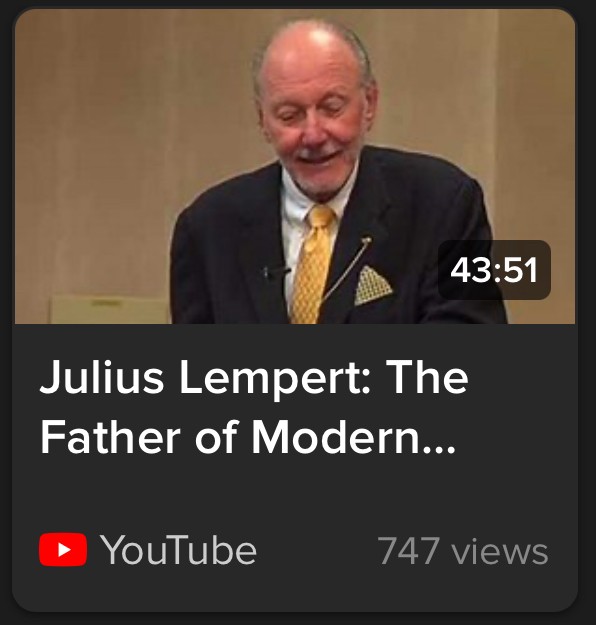
Dr. Julius Lempert (1891–1968) — the outsider the gatekeepers were wrong about.

Dr. Julius Lempert — our namesake, more or less
Julius Lempert was born in Lublin, Poland, in 1891 and arrived on New York's Lower East Side as a boy of thirteen. He was small, scrappy, and — by every conventional measure — precisely the sort of person the medical establishment was built to keep out.
He went straight from high school into a medical school then rated bottom-tier, which barred him from the internships and residencies that minted "real" specialists. Determined to become an ear, nose, and throat surgeon anyway, he simply showed up: observing operations over the shoulders of the city's doctors until, one clinic at a time, they asked him to stop coming.
Shut out, he opened his own office and built the busiest ENT practice in New York through methods the profession found scandalous — including splitting his fees with the doctors who referred patients. He operated at a furious pace and poured the proceeds into oil paintings, Broadway productions, and a chauffeured Cadillac.
His real revolution was technical. Where surgeons still cracked open the mastoid bone with a mallet and gouge — routinely destroying nerves and hearing — Lempert reached for a dental drill, and was thrown out of the operating room for it. Today every such operation uses a descendant of that drill. He worked under a bright headlamp and magnifying loupes that anticipated the surgical microscope, and filmed his procedures when almost no one else did.
Then came the work that made him world-famous: a one-stage fenestration operation that restored hearing to people with otosclerosis, proving it was safe to operate on the inner ear. Surgeons crossed oceans to watch. He founded his own institute, taught temporal-bone courses that still echo in the curriculum, and trained a generation of otologists who trained the next.
He did all of this as a poor, Jewish, "third-rate"-trained general practitioner in an era of open antisemitism — and ended, by any measure, the father of modern otology. The honors arrived eventually: gold medals, a foreign knighthood, an honorary degree from the Karolinska Institute.
We named a satirical newspaper after him because his life is the joke we keep telling: that credentials and merit are not the same thing, that gatekeepers are reliably wrong about outsiders, and that being underestimated is a renewable resource.
- National Library of Medicine (PMC) — scholarly profile of his career
- Mayo Clinic Proceedings — on his pioneering contributions
- JAMA Otolaryngology — archival article
- Ear, Nose & Throat Journal — "When House Met Lempert" (2023), on his meeting with otologist Howard House
- The New York Times — 1968 obituary
- Smithsonian — National Museum of American History object
- SlideShare — illustrated overview of his work
- Find a Grave — memorial
- Vanderbilt University (YouTube) — a talk by Michael Glasscock, MD recounting the story of Julius Lempert [link unavailable]
- "Julius Lempert: Father of Modern Otology" — the full biography, source of this summary
"A civilized society is one which tolerates eccentricity to the point of doubtful sanity." — Robert Frost
★Radical Mental Exploration in the Modern Eon
A short list of places to go looking. Footnotes encouraged.
- DuckDuckDuckGo* Search without being searched. Recursively, if necessary.
- PubMed Thirty-five million citations, for when a vibe is not enough.
- The Hub An encyclopedia entry about a certain library. We're not saying a word.
- The Unredacted Primary documents the authors never meant to footnote. Cite at your own clearance level.
- YouTube† Where knowledge hides between two unskippable advertisements.
- 🍎 Music 🍎 Podcasts 🍎 Books Apples. A basket of three, each keeping entirely different company. None of them the forbidden kind.
- Wolf Packs A computational wilderness where the rams do the arithmetic so you don't have to.
- Archaeological Sites Vast, hushed, and full of buried knowledge, catalogued by the dig team. What to do while there.
- Word(le)s‡ Definitions in any order you like. Six guesses not required.
- Precursors to the PDF Foundational documents, pre-flattening. Best viewed at 100%, under glass.
- A Reasonable Use of Tax Dollars Occasional, audited proof that a line item was worth it.
- Perspectives You May Not Know Exist Economic viewpoints rarely assigned as homework.
- Revealing Photos Photographs that leave nothing to the imagination — a cross-sectional tour of the head and neck, with a second opinion on every other region.
- Your Fellow Man§ Generally well-meaning. Results may vary.
- Starving Artists‖ Underfed, overqualified, and everywhere once you start looking.
- The Internet as a Whole All of it, at once. A snorkel is recommended.
- A Doctor¶ Preferably one you have met, in a building, in person.
- Snot Rags The day's reporting, with the toll booth quietly removed.
* Can be used to search for more search engines, ad infinitum.
‡ Physical copies remain at significantly lower risk of future data corruption.
‖ Or, better still, buy them lunch.
¶ On the importance of not taking everything quite so literally.
† Ads optional for those willing to never give up seeking knowledge.
"The most dangerous question isn't 'What happened?' It's 'Can I see how you calculated that?'" — The Lampoon Institute for Unhelpful Curiosity
★The Sim*
The Modern US Healthcare Simulator. Step into the waiting room and select a station.
*A simulation only. No actual care is dispensed, diagnosed, or — per our legal department — implied.
Did You Hear Something?
Sweep from a courteous 200 Hz to a conspiratorial 20,000 Hz. If the dog leaves the room, the apparatus is functioning as designed.
A pianoforte, as nature and the 18th century intended. Tap the button to change instruments.
An audible octave, provided in good faith for the humans present. The slider above is for everyone else. Mind the volume.
The Ear & Hearing
Three chambers, a chain of the body’s smallest bones, and a spiral full of hair cells you cannot afford to lose. A brief, mostly earnest tour.
Where Hearing Loss Happens
A Genuine Red Flag: Sudden Hearing Loss
Sudden sensorineural hearing loss (SSNHL) — a noticeable drop in one ear over hours to a few days, often with a plugged feeling, ringing, or dizziness — is one of the few hearing situations that is a true emergency. It is frequently mistaken for wax or a cold and quietly waited out. Don’t wait it out.
The window for treatment is short. Prompt evaluation (ideally within days) and a course of steroids — oral, or injected through the eardrum — give the best odds of preserving or recovering hearing. Started early, they often help; started late, they frequently can’t. If an ear suddenly goes muffled and a quick swallow or yawn doesn’t fix it, treat it like the urgent thing it is and get seen.
Ways Back to Sound
Which device fits depends on where and how much hearing is lost. An audiologist or ENT helps you understand the options available to you and how each one fits your hearing — the choice is yours. The below is a map, not a prescription.
The hearing aid already in your pocket
Recent AirPods Pro can run a built-in hearing test and, in supported regions, a clinical-grade Hearing Aid feature for mild-to-moderate loss — amplifying speech and dialing in to the screening result. It is not a replacement for a real audiogram or a real audiologist, and it won’t touch severe or conductive loss. But if you suspect you’re missing things, a five-minute test at home is a low-stakes, surprisingly decent way to find out whether it’s worth getting properly checked.
Cerumen Defense Force
A public-service arcade cabinet. Cotton swabs do not belong in the ear canal — they pack wax against the eardrum and, now and then, puncture it. Repel the incoming swabs. The canal thanks you.
Move: drag or ← → · Fire: tap or Space
Educational only, and no substitute for an audiologist or an ENT (otolaryngologist) — the doctors at the top of the hearing field — and the small flashlight they will produce. If sound is fading, a ringing won’t quit, or an ear feels blocked, see one of them — sudden hearing loss in particular is an urgent matter, not a wait-and-see one.
You Are the Surgeon Now
Recall Halsted’s seven principles of surgery from memory — one per box, in any order. The patient is, generously, stable.
Three Procedures — Now Operate
Pick one and perform it. Tap the glowing spot for each step. Simplified for the curious — emphatically not an operative manual.
Cardio Training
Two regimens clinically observed to elevate the pulse without a single step taken. Bring water. Bring composure. Lose both.
Further Viewing · For Pleasure, Not Instruction
- Rendi’s lowest fire cape world record
- Woox getting the first Infernal cape
- Settled’s Swampletics series
All of these creators are absolute legends.
The Real Thing: One Heartbeat, Drawn by Electricity
Every beat is a wave of electricity sweeping the heart in order — and the ECG is just that wave, written down. Each bump has a job.
SA node fires → the atria contract → the P wave. The signal pauses at the AV node (the flat PR segment), then races down the His–Purkinje wires to light up the ventricles — the tall QRS. Finally the ventricles reset for the next beat: the T wave. Atria depolarize, ventricles depolarize, ventricles repolarize — in that order, every single time, about once a second for your whole life.
Reading the Rhythm
Same heart, different stories. Pick a tracing.
Middlemen™
Premium Stakeholder Engagement Solutions
Because communicating directly is inefficient.
For centuries, civilization has recognized a fundamental truth: the best way to exchange information is to insert as many expensive third parties as possible between the sender and the recipient.
If you represent a pharmaceutical company, consulting firm, think tank, venture capital fund, private equity group, public affairs office, advocacy organization, lobbying concern, professional society, trade association, startup, disruptor, synergizer, innovator, consultant, consultant-to-consultants, or any other form of human middleman, you have come to the right place.
For a modest fee, Lempert's Lampoon may consider reviewing your request to determine whether it warrants eventual consideration for future review.
To ensure that only the most qualified middlemen reach our Editorial Board, applicants must complete the Stakeholder Worthiness Assessment™.
Estimated completion time: 3 minutes to 17 years.
- Click the button labeled "Continue." There are six buttons. None are labeled.
- Identify which pie chart represents "synergy."
- Upload proof that your organization has increased healthcare costs while simultaneously reducing value.*
* Most applicants automatically receive full credit.
Drag a file here, or click to upload your proof. - Rank the following buzzwords in order of importance: Innovation, Transformation, Disruption, Stakeholder, Paradigm, Holistic, Thought Leadership, AI. There is no correct answer. There are, however, several wrong answers.
- ⋮⋮1. AI
- ⋮⋮1. Innovation
- ⋮⋮2. Transformation
- ⋮⋮3. Disruption
- ⋮⋮4. Stakeholder
- ⋮⋮5. Paradigm
- ⋮⋮6. Holistic
- ⋮⋮7. Thought Leadership
- Locate the hidden prior authorization form. The form is hidden behind another prior authorization form.
Form PA-2 · Prior Authorization (for the Prior Authorization)
Select between six and nine attestations to submit. Each attestation you select opens a field. Each field must be completed.
- Watch a mandatory educational video entitled "Leveraging Cross-Platform Synergies in the Modern Stakeholder Ecosystem." Video length: 14 hours. Skip button appears after 13 hours, 59 minutes.
- Prove your worth. Submit three letters of recommendation, one yacht photograph, two conference lanyards, and evidence of having used the phrase "moving forward" during the previous week.
Click to upload your supporting materials.
- Complete a CAPTCHA designed by an increasingly hostile AI.
Select all squares containing your remaining patience. If there are none, reconsider.
- Explain why your message could not have been conveyed in a single sentence. Minimum word count: 2,000.
Words: 0 / 2,000
- The final challenge. Please locate the Submit button.
(Premium applicants may submit when ready.)
The Same Task, Two Ways
Your task: find the patient’s most recent potassium. On paper it’s one flip of a tab. Let’s watch the modern system improve on that.
Classifieds
Solicitations, surplus, and quiet desperation. Placed by readers like you.
Professional Services
Seeking experienced consultant to advise consultants. Must have advised advisors who advise.
Prior authorization specialist seeking authorization. References available upon authorization.
Wanted: someone to attend meetings on my behalf, and occasionally on my behalf's behalf.
Available: thought leader, currently between thoughts.
Otologist available for fenestration and the quiet drilling of very small bones. Brings own dental drill; will not be thrown out of your operating room more than once.
Surgeon can recall six of Halsted’s seven principles in any order. The patient is, generously, stable.
Stakeholder Containment services offered. We insert expensive third parties between you and whatever you were trying to say. Modest fee; eventual consideration for future review.
For Sale
For sale: lightly used strategic initiative. Never fully implemented. Still in box.
For sale: commemorative coin, later determined to be a regular coin.
For rent: moral high ground. Partially furnished. No parking.
Free: synergy. You haul.
For sale: one (1) shipping box, full to the brim with Afrin. Buyer assumes all oxymetazoline and any feelings about it. Contents non-returnable.
For sale: “Now That’s What I Call OR Playlists,” Vols. I–III, incl. Classic Rock & Hip-Hop editions. Lightly operated to.
Wanted: earplugs, the unglamorous foam kind. Will trade one (1) tuned cowbell, barely tolerable.
Lost & Found
Missing: accountability. Last seen entering a meeting; did not exit.
Lost: the situation with the elk. Reward offered; terms remain unclear.
Found: one (1) paradigm, slightly shifted.
Seeking: a second opinion on my first opinion.
Found: a red gas can on the shoulder of a wet two-lane road at dawn. A man in a tie was refueling a sedan by hand. He seemed fine. We did not ask.
Update: the situation with the elk has developed. It is now the situation with the elk and the harmonica. Reward unchanged.
Personals
Seeking: Dr. Vera — surname negotiable (Context, Fried, Decant, and Realitycheck all considered). Must be willing to be quoted at length by an invented think tank.
Staffer seeks compelling reason to remove the red clown nose before the 2 p.m. standup. Handwritten notebooks a plus.
Recognition sought: “Most Likely to Walk Like a Velociraptor,” class of ’12. Still does. Seeking someone who gets it.
You: sent a dumb e-mail. Me: also, repeatedly. Coffee? Reply-all if you must.
Notices & Announcements
The Airing of Grievances (Vol. 1) now accepts submissions for Vol. 2. Grievances must be petty, sincere, and alphabetized.
Public notice: the Office of Stakeholder Containment does not acknowledge requests, receipt of requests, or its own existence. Thank you for your interest.
Correction: a headline last issue should have read “Falls Church,” not “Falls, Church.” We regret the pause.
Since 1978 we have shone a light on the absurd. The lamp now flickers on a schedule — for ambiance, and plausible deniability.
Instruments & Curios
For sale: fretless bass. No frets, no excuses, essentially microtonal. Intonation conveys to buyer as-is.
Free to good home: one dog with strong opinions about frequencies north of 17 kHz. Leaves the room when the apparatus is functioning as designed.
Wanted: a diploma from Universitas Mental Floss to match the one already framed. Field of study immaterial — the frame is the credential.
Available: one prize check, 275th Orange County Art/Essay Contest (2009). Suitable for framing, light bragging, or both.
Public Records Requests
We are committed to transparency. In principle. Pending review.
Your request has been received and assigned tracking number ██-████-██.
After careful review, the requested document has been classified, declassified, and then reclassified out of an abundance of caution. The relevant portions are reproduced below:
███████ ███ █████ ██ ████, ████ ███ ███████ ████ ████.
Estimated response time: 6–8 business decades. Your request has been forwarded to the Office of Stakeholder Containment, which does not acknowledge requests, receipt of requests, or its own existence.
Certificate of Sincere™ and Heartfelt™ Apology™
The Editorial Board wishes to express its deepest, most authentic, most stakeholder-aligned regrets regarding whatever circumstances have brought you to this page.
After extensive review, consultation, stakeholder engagement, committee formation, committee expansion, committee oversight, committee oversight oversight, and strategic reflection, we have concluded that your concerns are both valid and profoundly unfortunate.
We therefore offer this Sincere™ and Heartfelt™ Apology™ as evidence that your complaint has been acknowledged. Whether it has been addressed remains outside the scope of this certificate.
Hereby and reluctantly extended to
Type your name — it prints onto the certificate.
More or Less
Patient Education
Because occasionally something here should be useful.
Saline Sinus Rinse: How to Do It Safely
If you are a stick figure, the following constitutes medical advice. Otherwise, it does not — please consult a physician, a pharmacist, or the right specialist for the problem: a physical therapist, occupational therapist, speech-language pathologist, or audiologist, as the case may be.
Saline nasal irrigation (a “sinus rinse”) flushes mucus, allergens, and irritants from the nasal passages. Physicians and pharmacists commonly recommend it for sinus congestion, allergies, and the lingering stuffiness of a cold. The steps below follow the manufacturer's directions for the NeilMed® Sinus Rinse bottle and NasaFlo® Neti Pot. NeilMed is one widely available brand — not the only option. Other rinse devices and pre-mixed buffered-saline products work on the same principles.
Two Things Matter Most: The Water and the Mixture
These two carry roughly equal weight. The water has to be safe, and the buffered saline has to be mixed to the right strength — get either one wrong and the rinse becomes, at best, deeply unpleasant.
What You Need
- A NeilMed® Sinus Rinse squeeze bottle or NasaFlo® Neti Pot.
- One pre-mixed saline packet — convenient and consistent. You can also mix your own, but it takes extra care to get the concentration right.
- Safe, lukewarm water (see above).
Steps
- Wash your hands. Add one saline packet to the bottle. (Forgetting the packet is a common mistake and causes an unpleasant burning sensation.)
- Fill with safe, lukewarm water to the line. Cap it, place a finger over the tip, and swirl gently to dissolve the mixture.
- Stand in front of a sink, bend forward, and tilt your head down. Keep your mouth open and do not hold your breath.
- Place the cap snugly against one nostril and gently squeeze. The solution will drain out the other nostril, and some may reach your mouth — that's normal.
- Blow your nose gently without pinching it completely shut. Repeat on the other side.
- Tip: rinsing about an hour before bedtime helps avoid residual solution dripping down your throat.
The Rinse, Illustrated
The same steps, with stick figures and questionable composure:
Clean the Device
After each use, wash the bottle or pot and cap with safe water and a little soap, rinse, and let it air-dry on a clean surface. Use fresh solution every time, and replace the device about every three months for hygiene. Do not share rinse devices.
This handout is general information, not a substitute for advice from a physician or pharmacist. If you have any questions or concerns — including which product to choose — ask the staff at your local pharmacy or speak with your physician directly.
Bonus: Afrin® Overuse Self-Screening
A validated*, single-image instrument for the early detection of oxymetazoline overenthusiasm.
*Not validated. Rebound congestion is, however, very real.
Self-Screening · Item 1 of 1

Does this image leave you confused, or in awe?
Aim the Spray: Lateral, Not at the Septum
The most common nasal-spray mistake is pointing it straight at the wall between your nostrils — the septum. Aim it gently outward, toward the same-side eye or ear, and use the opposite hand (left hand for the right nostril). Pick an aim and spray.
What the Septum Cannot Survive
A cautionary demonstration — emphatically not a how-to. Cocaine is a potent vasoconstrictor: on the nasal lining it clamps shut the tiny vessels feeding the septal cartilage. Starved of blood, the tissue dies, and a hole opens. Watch what repeated use does — then never do it.
Misuse, overuse, and reckless use of drugs — illicit or prescribed — harm tissue and lives in ways that don’t undo. If a substance has a hold, that isn’t a moral failing; it’s a medical problem, and help exists. Ask a physician, a pharmacist, or a trusted person — the earlier the better.
First: always ask whether a generic equivalent exists. A generic carries the same active ingredient, strength, and FDA-required bioequivalence as the brand — at a fraction of the cost. “Is there a generic?” is one of the highest-yield questions in all of medicine.
Second: never hesitate to ask the pharmacist or pharmacy staff. They’re among the most accessible experts you have — free to talk to, no appointment needed. Ask about interactions, cheaper alternatives, discount programs, how to take something, or what a side effect means. Asking for help is the competent move, not the embarrassing one.
And on who to ask: aim for the person at the top of the relevant field — a physician for diagnosis and treatment, a pharmacist for medications, a physical therapist for movement, an occupational therapist for daily function, a speech-language pathologist for speech and swallowing, an audiologist for hearing. These are different lanes, not a ranking of people — each is the expert in theirs. And the door to those top roles should open for anyone capable of earning it: by ability and the work it takes, not by knowing the right people.
“Just a gluttony of spoonfuls of sugar helps the medicine return, the medicine return, the medicine return.”
Now being performed, against everyone’s wishes, by the in-house vocalist.
Receptors & How Drugs Talk to Cells
A real drug doesn’t need to be diluted into oblivion to do something. It needs a receptor — a molecular lock — and the right key.
Cells are studded with receptors: proteins that wait for a specific signal (a hormone, a neurotransmitter) and, when it binds, change what the cell does. Drugs work by impersonating, blocking, or nudging that conversation. Four words cover most of it:
The Bench
A patch of cell membrane with a dozen receptors. Add molecules and watch the cell’s response — then make the cell adapt.
Why the Cell Fights Back: Up- & Down-Regulation
Cells defend a set-point. Flood a receptor with agonist for long enough and the cell down-regulates — it pulls receptors off the surface and dials down the response. That’s tolerance: the same dose does less. Chronically block a receptor and the cell does the opposite, up-regulating — building more receptors to be heard. Remove the blocker suddenly and the now-oversensitive cell overshoots: that’s rebound and a chunk of what makes withdrawal so miserable. The Afrin trap two pages over is exactly this story, in a nostril.
Simplified to the point of caricature for teaching — real receptors involve binding kinetics, second messengers, and far more arithmetic. But the shapes are right: agonists push, antagonists block, competition can be outrun, and cells adapt to whatever you do to them.
Tug on the Ear of the Editor(s)-in-Chief
We value all reader feedback, including the wrong kind.
Lempert's Lampoon will never sell your personal data. We do, however, continue to operate portions of our digital infrastructure using a Hotmail account that has already demonstrated a concerning willingness to become someone else's Hotmail account. Proceed accordingly. Full policy →
Are you a fan of Lempert's Lampoon?
Select Yes to send compliments, fan art, or threats of marriage. Select No to send gripes, grievances, and your theory that satire is the lowest form of communication — after one brief, legally enchanting notice.
Choose wisely.
& Duly
Noted
Thank You for Contacting Lempert's Lampoon
Your feedback has been forwarded to the Editorial Board.
A team of highly trained specialists is currently reviewing your submission and determining whether it represents:
- Constructive criticism
- A misunderstanding
- A profound misunderstanding
- Material suitable for publication
Please allow 6–8 business decades for processing.
Permanent Registry of Questionable Judgment
Registry currently contains everyone who selected "No."
Individual entries are withheld for their own protection, and for ours. Names may be reviewed during editorial meetings, holidays, and moments of quiet reflection.
Legalese
The dull, the binding, and the mandatory — gathered in one place so they bother you less often.
Jury Duty and You
Four pieces of required viewing. The order of evidence reshuffles on every visit — justice, like our scheduling, is random.
Spectrum Self-Inquiry
A brief, scientifically adjacent questionnaire. Answer honestly, or don't.
Further Reading
A small, sincere shelf — real resources and peer-reviewed work on autistic identity, stigma, employment, and lived experience. The one part of this section that isn’t joking.
- NeuroLaunch · plain-language explainers for learning more
- Psychology Today · find a qualified professional near you
- Frontiers in Psychiatry · autism, mental health, and co-occurring experience (2023)
- J. Autism & Developmental Disorders · identity and lived experience (2021)
- Scientific Reports · a study in autistic perception and cognition (2017)
- Autism · community and lived-experience research (2024)
- Issues in Mental Health Nursing · autistic people and mental-health care (2023)
- Turnock & Langley · Understanding Stigma in Autism (PDF)
- Scientific Reports · autism research (2024)
- Disability & Society · autism, disability, and society (2024)
- J. Autism & Developmental Disorders · recent research (2025)
- Autism in Adulthood · autistic adulthood and self-understanding (2021)
- Medical Education · autistic medical students’ experiences
- Scientific American · a broken employment system leaves autistic adults stranded
- The Autistic Scientist · unemployment and underemployment, first-hand
- Current Developmental Disorders Reports · review (2024)
- PMC · open-access research on autistic adults
- Clinical Psychology Review · autism and mental health (2022)
- Centre for Suicide Prevention · suicidal thoughts & behaviours and the autism spectrum (PDF)
- PMC · open-access research on autistic adults
The Organ Doing All of This
Every result above — every trait, every difference, every self-inquiry — runs on roughly three pounds of tissue we understand far less well than we pretend.
A Note on Humility
We can name the lobes and color the scans, but the basics still escape us. We do not really know how a memory is stored, how anesthesia switches consciousness off, why we sleep, or how 86 billion neurons add up to the feeling of being someone. The map is gorgeous; the territory is mostly unread.
Which makes it a particular kind of funny that, having barely diagrammed one brain, we’ve declared we can rebuild its intelligence out of graphics cards — chips designed to draw triangles quickly, now stacked by the warehouse and asked to think. They do remarkable things. They are also nothing like a neuron, run on roughly the power of a small town, and cannot tell you why you like the things you like. We are reverse-engineering a device whose manual we have never found, and confidently shipping the clone. The Lampoon finds this equal parts thrilling and absurd, which is generally a sign something interesting is happening.
And if you have ever suspected that everyone else was handed an instruction manual you somehow never received — it has been located. The secret to world peace, while we had the drawer open, turned up right beside it: here.
Self-Service Optometry
Adjust your own prescription. We trust you completely.
Slide until the chart is legible, then write yourself a prescription. Each eye is calibrated independently, because your eyes were never really a team.
Drag each pupil ● in the panel above to set your distance.
Not a substitute for an optometrist or ophthalmologist — one with a real machine and a small flashlight they will shine directly into your soul. Move the two dots until they align with your actual pupils for results that are no more accurate, but feel personalized.
The Retina & How You See
The eye is a camera for about a millimeter. After that, vision is almost entirely a story your brain tells — and mostly gets right.
From Photon to Picture
The cornea and lens focus light onto the retina, a sliver of neural tissue lining the back of the eye. Its photoreceptors come in two flavors: rods (exquisitely sensitive, night and motion, no color) and cones (daylight, fine detail, three types for color). They’re packed densest at the fovea — a pinhead of retina that does nearly all of your sharp, read-this-sentence vision. Everything else is your peripheral vision quietly bluffing.
Here’s the strange part: the retina doesn’t send a picture. It sends differences — edges, contrasts, motion, changes — down the optic nerve to the brain, which crosses the signals at the optic chiasm, routes them through the thalamus, and reconstructs “seeing” in the visual cortex at the very back of your head. You don’t see with your eyes so much as through them.
Find Your Blind Spot
Where the optic nerve leaves the eye there are no photoreceptors — a literal hole in each retina. You never notice, because your brain paints over it. Here’s the classic demo that catches it in the act.
Cover your left eye. Stare at the + with your right eye. Slowly move toward the screen (about 30–50 cm). At one point the ● vanishes entirely — that’s its image landing on your blind spot. Your brain fills the gap with background as if nothing were missing.
The Same Lens, Pointed at the Invisible
The eye focuses the world with a single curved lens. Aim that same trick at a drop of pond water and you find a second world that had been there the whole time.
Tap the lens to look through it — the world he saw first.
Microscopy is just the eye’s physics, pushed further. A curved lens refracts (bends) light to magnify what’s otherwise too small to resolve — the very same bending your cornea and lens use to focus an image on the retina. The first compound microscopes appeared around 1600 in the Netherlands, and in 1665 Robert Hooke’s Micrographia dazzled London and handed us the word cell, after the bare little boxes he saw in a sliver of cork.
But the man who saw furthest wasn’t a scientist at all. Antonie van Leeuwenhoek (1632–1723) was a cloth merchant in Delft who used magnifying glasses to count the threads in fabric — and got curious. Grinding his own minuscule glass lenses, he built simple, single-lens microscopes that reached roughly 270×, sharper than any bulky compound instrument of his day. Through them he became the first human to see a living microbial world: bacteria, protozoa and other “animalcules,” alongside blood cells, sperm cells, and blood actually coursing through capillaries.
He reported it all in plain-spoken letters to the Royal Society in London, was elected a Fellow in 1680, and is remembered as the father of microbiology. He never did reveal exactly how he ground his lenses. A draper, a few grains of polished glass, and ordinary curiosity — and the invisible became a field. The Institute notes, without further comment, that he began by checking thread counts.
Through the Looking-Glass · Delft, c. 1674–1700
What Antonie van Leeuwenhoek Saw First
Educational only. Real visual neuroscience is a career, not a webpage. If your actual vision changes — a new blind spot, a curtain, sudden floaters or flashes, distortion — that is an eye doctor today, not a fun fact.
Alignment Zone
Chiropractic care, distilled to its essential exercise.
There is nothing else on this page.* There rarely is. Assemble the skeleton below into its correct configuration. You will be notified when you are correct.
*Technically, only true for those who lack curiosity.
The skeleton is, by at least one definition, aligned. Results are spinal, spiritual, and entirely unverified.
Scores are kept locally, in this very browser, on an honor system of one. The top 67 per board are preserved for posterity; the 68th is encouraged to try harder.
What’s Actually Down There: The Musculoskeletal System
Before anyone “adjusts” it, it helps to know what it is. Three parts, one job: hold you up and move you around.
Bone Is Alive, and It Remodels
Bone isn’t inert scaffolding — it’s living tissue that rebuilds itself along the lines of stress it feels (Wolff’s law). Load it sensibly and it strengthens. Traumatize it repeatedly and it… overcompensates. A demonstration with a wrench and a regrettable jaw:
In real life this is exactly how repeated stress builds bony overgrowths — exostoses and bone spurs, “surfer’s ear” in the cold-exposed ear canal, a torus in the jaw. Bone answers force by laying down more bone, in whatever lumpy shape the force suggests. Be kind to your mandible.
Muscle Answers to Electricity: Galvani’s Frog
In the 1780s Luigi Galvani touched a dead frog’s leg with metal and it kicked — the discovery that nerve and muscle run on electricity (“animal electricity”). Every muscle you have ever moved did it the same way. Run the experiment.